Global Security Headlines

Showing posts with label NE Asia. Show all posts

Friday, November 26, 2010

The North Korean Menace - Time for the stick?

The deadly artillery bombardment of South Korea's Yeonpyeong Island is yet more evidence that the cartload of carrots thrown at the North Korea nuclear impasse over the years has only emboldened the dictatorship in Pyongyang.
Kim Jong-Un to rescue

Spoiled Child in Pyongyang
The North Korean case is a perfect example of sparing the rod, spoils the child.

The impish regime in Pyongyang like most autocracies consumed the inducements, used negotiations to advance its nuclear program to fruition, and correctly interpreted the constant request for negotiations as a sign of weakness.

Today, North Korea stands at the brink in the death throes of a desperate transition to the Kim Jong-Un, Kim Jong-Il's youngest son. He is yet another corpulent member of the ruling family in a country that has suffered repeated episodes of famine, but obviously the ruling class was not affected. The twenty-something neophyte is supposed to save the dying regime?

China, who is the mother to the childish regime, is the key to resolving the North Korean imbroglio. For fear of disrupting any access to the lucrative Chinese consumer market and offending its banker, the United States is loathe to bluntly tell Beijing to solve the problem or have it solved.

American impotence to defend an ally from a regional bully is noted not just by China but its enemies around the world.

The North Korean menace ranges beyond the spooky corner of Northeast Asia. Pyongyanh is also heavily involved with Iran and also ships arms to terrorist groups like Hizbullah.

Higher Cost to End the Crisis
Now a declining yet nuclear-tipped Pyongyang threatens war with South Korea as Seoul prepares for naval exercises with the US.

World history is replete with examples that those who live by force like the thugs in Pyongyang only respect force. Why this is such a hard concept for many to grasp in the world capitals of democracies is baffling. Regime behavior can only be moderated by the stick since carrots only fatten resolve.

The cost of solving the North Korea case is higher now because past opportunities were squandered at the negotiation table as if (same for Iran) a rogue regime has any interest in volunteering ceding its chip at the table of international diplomacy.

A unified Korea, yes bordering China, under democratic control from Seoul, should be the goal and the appropriate measures should be undertaken to achieve it.
***
If you need research from open sources in Spanish, French, or Portuguese and presented in a stylish English language report or a translation of documents in said languages to English, please contact Professor Winn at by sending an email to mrenglish101@gmail.com for a prompt evaluation.

Tuesday, November 2, 2010

Sino-Ruso Gangup on Japan?

In late September, China and Japan clashed over the Diaoyutai Islands (Senkaku in Japanese).

Russia's Move
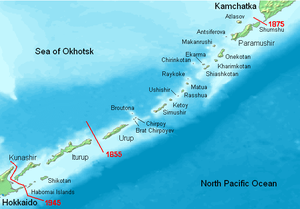
Yesterday Russian President Dmitry Medvedev drew Tokyo's ire when he visited Kunashir isle, one of the four disputed with Japan since the end of World War II.

The provocative step is consistent with stoking Russian nationalism on full display in the Victory Day last May in Moscow and comes ahead of a regional summit between the two countries.

Mr. Medvedev's visit was a milestone since he is the first Russian leader to visit the island group.

Japanese Foreign Minister Naoto Kan reasserted Japan's claim to its ''northern islands'' and called the visit ''regrettable.''
 
Japan recalled its ambassador to Moscow in response to the latest territorial tiff. 

Russo-Sino policy in tandem
Is there another reason to up the pressure on Japan?

Some Japanese observers see a joint Russo-Sino gang up on territorial disputes with Japan.

Evidence grows of  a stronger ''strategic partnership'' between Beijing and Moscow especially in the Pacific region.

The fight over the four Kuril Islands stems from the vagaries of the post-World War II conferences in Postsdam and Yalta and the fact that the Soviet Union did not sign the Treaty of San Francisco.

The United States thus never supported the Soviet claim over the isles and still sides with Japan today.

***If you need research from open sources in Spanish, French, or Portuguese and presented in a stylish English language report or a translation of documents in said languages to English, please contact Professor Winn at by sending an email to mrenglish101@gmail.com for a prompt evaluation.

Saturday, November 7, 2009

Cold War Series Part I: Soviet Communist Ascendancy


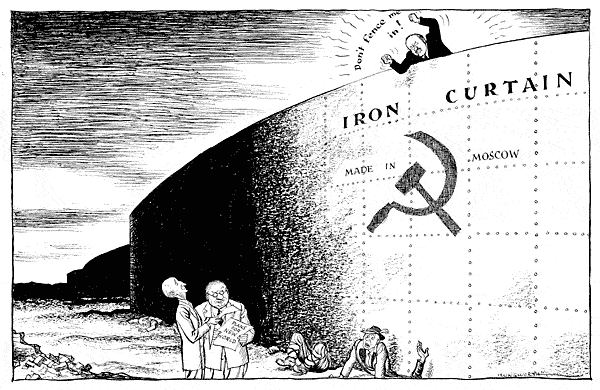
November 9, 2009, marks the 20th anniversary of the fall of the odious Berlin Wall, a symbolic event for ushering in the end of the Cold War. An ´´Iron Curtain,´´ separating East and West Europe, walls, vicious guard dogs, prison camps, barbed wire, minefields, no-mans land, Checkpoint Charlie, and soldiers at the ready were implements of tyrannical regimes to enslave their people, dash their dreams, and maintain total control through the gun barrel.

The Western democracies led by the United States rejected this barbarism.

GSM in a four part series reviews the Cold War. Part I covers the ascendancy of Soviet communism. Part II shows how the Cold War was not won. Part III demonstrates how the West´s iron-willed determination forced Moscow to relent. Finally, Part IV expounds upon the lessons learned which are applicable to the current international system.

 From the ashes of World War II sprang almost immediately the Cold War, the titanic struggle between the West (NATO) and the East (Warsaw Pact). Namely, the United States and the Soviet Union managed a rivalry across the global chessboard for supremacy. Would tyranny and command economics triumph over freedom and market economics? For 46 years, the two sides competed for prestige, allies to carry forward the fight, and of course, victory.

The early contests began in the divided Germany - Federal Republic of Germany (West Germany) and the German Democratic Republic (East Germany) in the former Nazi capital - Berlin. The West led by US President Harry Truman defied Soviet attempts to block land routes into western Berlin (where the western Allies had divided the capital into zones) with a massive airlift transferring supplies to 2.2 million inhabitants. The Soviets did not act to stop the airlift and the crisis abated and West Berlin became an island of freedom and market economics in the heart of East Germany. West Berlin and the divided Germany would be a constant thorn in the side of the Soviet Union throughout the Cold War.

The US-Soviet rivalry stretched across the globe touching every continent. US President Truman believed China´s helped spark the Korean Conflict which was fought to a stalemate. That unsettled conflict precipitated a challenge later in Vietnam where first the French were evicted by a nationalistic communist insurgency and later the United States who left the quagmire with a shameful defeat. The dominoes fell later as predicted in Laos and Cambodia who also fell under communist tyranny. Re-education camps and ´´the killing fields´´of Cambodia proceeded to subject millions to a fate of certain death.

Indeed, the 1970s can arguably be the apogee of Soviet communism. The West was reeling. Many observers believed Moscow´s march was unstoppable and that capitalism was a spent force. At the height of the Arab-Israeli War in 1973, US President Nixon put the country on DEFCON3 (Defense Readiness Condition) to deter the Soviets from intervening.

However deadly serious, the second direct confrontation between Moscow and Washington occurred a decade earlier during the  Cuban Missile Crisis of 1962 which nudged the United States and the Soviet Union closer to mutually assured destruction (MAD). The wily Castro in Havana and reckless Khrushchev in Moscow pushed the US Kennedy Administration to the brink over nuclear missiles in Cuba.

These hot points during the Cold War again redounded to a test of wills. Join us for Part II of our series where we explore how the Cold War was not won. Our final post on the series reflects more on the extraordinary time period the Cold War covered in world history and lessons applicable to global security challenges today.

Get your International Policy books today!

Monday, March 16, 2009

North Korea I: Clear and Present Danger to Global Security

Dangerous DPRK

The Democratic People's Republic of Korea (DPRK) a/k/a North Korea is another clear and present danger to global security like Iran. The nuclear genie out of the bottle worries global security planners and observers alike.

North Korea is nuclear and is testing long-range missiles to deliver these payloads while sharing (selling) its technology with other pariah regimes across the globe like a nuclear reactor in Syria.

Who leads the DPRK?

The DPRK is a mysterious country cloaked in secrecy, opaqueness, and intrigue. Its Juche philosophy - extreme self-reliance and sacrifice for the North Korean state - remains its guiding body of principles. After the collapse of the Soviet Union, Pyonyang has become more militarily bellicose and politically isolated.

An apparent ailing Kim Jong-il has sparked a leadership crisis for the regime amidst its confrontation with its neighbors and the US over its nuclear program. Its economy is moribund. The populace "continues to suffer from prolonged malnutrition and poor living conditions." Its military, winner of most state resources, is poised to unleash a scorching artillery and missile barrage on South Korea and overrun its familiar nation.

What next for the DPRK?

A wounded animal fights to the death. The DPRK is spiraling downward for either a hard or soft landing. Its fragility however is no reason to recoil from the difficult task ahead. Our next post examines the military situation on the Korean peninsula and in our third post we discuss the red lines for a policy cracking the Korean chestnut that vexes global security policy makers.

Get your International Policy books today!