Global Security Headlines

Showing posts with label Brazil. Show all posts

Saturday, January 1, 2011

Top 6 Strategic Questions for 2011

The past is prologue.

As we go forward, issues trending in the international affairs arena in 2010 are poised to intensify in 2011.

It is easy to get lost in daily press reports and miss the fundamental understanding of what really is happening.

While no one can accurately predict the future course of global security no more than the weather, informed estimates of military and diplomatic analyses must be made.

As GSM peers down the road, we ask the following 6 Strategic Questions (see our questions in 2010) to provoke thought and focus debate on the issues impacting global security now and likely in the near future.
_____________________________________________________
1. Does despotism deepen in Russia ahead of 2012 presidential elections? Putin's Russia slid closer to a  one-man rule in 2010. Curiously the titular president Medvedev pressed his US counterpart Obama to ratify the ''new'' START Treaty for reductions in nuclear ICBMs and limits on future development of any anti-ballistic missile systems. But, the Russian Duma did not see any urgency at all and deferred any action until this year. The rule of law was severely weakened with the recent imprisonment of Mikhail Khodorkovsky and Platon Lebedev, former Yukos oil executives, for what many observers see as a penalty for opposing Putin. His grip is tightening on all parts of the government ahead of his expected run in the 2012 presidential elections.

2. Is the Middle East destined for another armed clash? The Economist muses about clashes between Israel and Iran, its newly-replenished Hamas and Hizbolla proxies, and even Syria over Tehran's nuclear quest. Events last year could precipitate fighting in 2011. The spectacular failure of the latest US-led round of Palestinian-Israeli peace talks weighs on the scale. While estimates vary of when Iran may ''go nuclear'' given delays from the Stuxnet computer virus attack, it is possible Israel could decide to act sometime this year.

3. Can Calderon of Mexico save his country from narcoterrorism? Mexico is torn asunder by the war between the narcotraficantes and the government and internecine savagery between rival cartels for primacy. More than 22,000 have died since Presidente Felipe Calderón cracked down on the narcos and the border with the US is on fire. The systemic corruption, a weak judiciary, and suspect  federales only complicate any ''victory'' over the well-armed and well-financed narcos. US planners as far back as 2008 pondered a total collapse of the country. Calderón must act decisively to avoid that fate.

4. Does Brazil solidify its ''middle power'' status and stand up for freedom? Happy talk surrounds Brazil, Latin America's largest country and economy. Brazilians begin 2011 with a new president, Dilma Rousseff, the first female to take charge in Brasilia. Its oil success, if managed well, could pave the path to an economically stronger and less poorer regional  hegemon. Outgoing President Lula left Brazil better after 8 years of rule. However if Ms. Rousseff continues his left-bent embrace of neighbor Chavez and outreach to Iran by meddling again in the nuclear question, the turn away from supporting freedom abroad would detract from Brazil's attempt to gain international currency. Is Brazil ready for prime time?

5. Does India effectively balance against the Sino-Pak encirclement? China is India's chief adversary in south Asia. Beijing's ''string of pearls'' encirclement of India is nothing new. As both a maritime and land power, its regional power projection gives New Delhi options to counter the Sino-Pak gambit. US President Obama's visit last November bolstered India's standoff with both its neighbors. The chaos in the Afghanistan-Pakistan theater and China's rising aggressiveness challenge India to chart a delicate course.

6. Is there peaceful reunification on the Korean peninsula? Leadership transitions in totalitarian regimes are often dicey deals and in a regime as opaque as North Korea, doubly. Kim Jong-il named his third son as successor, a mere 27 year-old, to head up the dying regime in Pyongyang. While some observers say the transition is in its early stages, it is clear that freedom-loving countries including South Korea can barely spare any more existence of the nuclear-tipped, nuclear proliferating, and otherwise thuggish gang in Pyongyang. China, however, does not want a democratic and unified Korea on its border and thus continues to subsidize and prop up the NE Asian menace. Along with its proxy Iran, China can frustrate US goals in the respective regions. North Korea is enriching uranium and antagonizing the South at will, all in the throes of a transition. Is it possible the Pyongyang gang's lease on life is running short?
_____________________________________________________
GSM is committed to providing the keen analysis our loyal readers demand and deserve.

Count on our continued commitment to providing the information and insights you have come to enjoy.

Happy 2011!

***If you need research from open sources in Spanish, French, or Portuguese and presented in a stylish English language report or a translation of documents in said languages to English, please contact Professor Winn at by sending an email to mrenglish101@gmail.com for a prompt evaluation.

Sunday, October 31, 2010

Brazil's Rocky Road Ahead

 Sao Paulo, 31/10/2010, 11h54BST
Dilma Rousseff

Worldwide headlines in the papers today point to an expected win by Worker Party (Partido dos Trabalhadores, PT) Dilma Rousseff in the second round to succeed her mentor and current President Lula da Silva of Brazil.

Red flags abound surrounding the choice of Ms. Rousseff to lead Brazil.

A vote for Ms. Rousseff is blind. There is no evidence she is ready to lead Latin America's largest country and economy.

A rather empty and nasty campaign based on Lula's reputation and success propelled her bid. His accomplishments - not hers.

Ms. Rousseff is a ''true believer'' as a former leftist revolutionary during the military government. But, once a leftist revolutionary always a leftist revolutionary.

Press restrictions are on their way to Brazil as authoritarianism grows under PT one-party control.

Press censorship will undoubtedly redound to erosion of personal freedom.

The Brazilian experiment with democracy (just a short 25 years) will be challenged severely in the future with the continuance of statists in power. 

The projected victory of Ms. Rousseff today opens a new chapter in Brazil's history.

While ''continuity'' was sold to soothe the country's doubts about her since her radical past is well-known, it is a mirage.

Expect a sharp left turn ahead instead.

Brazil faces a rocky road ahead on many fronts.
***
If you need research from open sources in Spanish, French, or Portuguese and presented in a stylish English language report or a translation of documents in said languages to English, please contact Professor Winn at by sending an email to mrenglish101@gmail.com for a prompt evaluation.

Monday, October 25, 2010

Brazil to Polls Next Sunday

Sao Paulo, Brazil - 21h50 - Sunday - 

It appears the leftist Workers Party candidate, Dilma Rousseff, is still the favorite to succeed the party's popular incumbent President Lula in Round Two of Brazil's presidential election.

However, more one-party rule intrigue and the gender gap have surfaced as the election nears.

Apparently, audio recordings attest to the fact that the Justice Ministry received requests by Ms. Rousseff and others to compile dossiers on her political adversaries, according to Veja magazine.

On Sunday, the daily  Folha in Sao Paulo revealed payments were made to workers in the ministry for the dossier.

In a separate report, Folha reported a gender gap as ''Dilma's Achilles heel.''

However, the gap is not what you may suspect. More men (51%) support Ms. Rousseff than women (43%)!

Is there sufficient doubt about the sanity of one-party rule given the reported abuses of power? Can she bridge the gender gap in time?

Veteran observers say ''yes,'' but what about the voters on Halloween Sunday?
***If you need research from open sources in Spanish, French, or Portuguese and presented in a stylish English language report or a translation of documents in said languages to English, please contact Professor Winn at by sending an email to mrenglish101@gmail.com for a prompt evaluation.

Monday, October 4, 2010

Brazil Election Update: On to Second Round

The final poll - the actual vote - painted a mixed picture on Sunday when Brazilians went to the polls to choose a new president, federal representatives and senators, governors, and state representatives.

The incumbent Partido Trabalhista (PT) made gains in the Senate, but President Lula's hand-picked favorite to succeed him, Dilma Rousseff, fell short of the 50%  needed to avoid a longer campaign and greater scrutiny. She scored only 46.9%, less than Lula's 48.9% in 2006.

Given a strong economy, an adored President Lula, and  party hacks engaged in chicanery to spy on her closest rival, the former Marxist guerrilla had the wind at her back. Yet she was thwarted from obtaining a clean sweep therefore forcing a second round on October 31.

Election polls before the election uniformly gave Ms. Rousseff a comfortable lead above the 50% mark ahead of her main rival bidding to replace Lula, Jose Serra of the Social Democrat Party, who scored 33% of the vote. His party racked up four governorships in the first round showing muscle at the state level.

The third candidate, soft-spoken Marina Silva of the Green Party, is now the king maker after grabbing nearly 20% of the vote. While her followers lean toward the Serra camp, four weeks is a long time in politics.

It is clear the unease reported in the pre-election post pervades the electorate. More than 50% voted against the incumbent PT party's candidate, Ms. Rousseff. She is not  Lula.

Her well-manicured campaign based almost solely on Lula's sky-high popularity backfired.

Now she will have to speak up and attempt to reassure the public her revolutionary past is really history and she is prepared to lead Brazil forward on its date with destiny as a powerhouse in the XXI century.

***
If you need research from open sources in Spanish, French, or Portuguese and presented in a stylish English language report or a translation of documents in said languages to English, please contact Professor Winn at by sending an email to mrenglish101@gmail.com for a prompt evaluation.

Saturday, October 2, 2010

Unease on Brazil's Election Eve, Dispatch from São Paulo

Dilma Rousseff, presidenta in waiting 
Dateline: São Paulo, Brazil, 18h02 BST

All that is left is the voting.

Short of a stunning reversal, Dilma Rousseff of the incumbent Partido Trabalhista (Workers' Party) will become Brazil's first woman president with a knock-out in the first round on Sunday.


Unease

Widely-popular President Luiz Ignacio Lula da Silva tapped her to succeed him and his adoration by the masses will probably translate into an overwhelming victory.

However, her own governing agenda is deliberately an enigma and her constant dodging of public debates with her lackluster opponents only can fuel unease about the prevailing thought that a vote for Dilma is a vote for continuity.

Sadly, it is not. There is no evidence Dilma will follow the same pragmatic policy prescriptions which conferred superstar status on President Lula.

As a former guerrilla fighter who was tortured upon capture in the 1970s during the country's right-wing military dictatorship, she is still a ''true believer'' cut from the Latin American Leftist revolutionary quilt.

The presidential contest has been marred by dirty tricks against Dilma's closet opponent, Jose Serra, at the hands of Partido Trabalhista apparatchiks in the bureaucracy, press censorship when the story leads too close to the ruling party, and sharp barbs by Lula aimed at the Fourth Estate for seeking the truth. All should be red flags for those voting for continuing one-party rule in Brazil.

However, Dilma's political career outside the ranks of revolutionary has been marked by controversies.

Socio-Economic-Political Success
Lula, to his credit, kept his predecessor’s liberal economic policy orientation and restored market confidence in Brazil by taming inflation and stepping up privatization.  A larger middle class has rapidly emerged since 2003. Over 30 Brazilian firms figure in Forbes 2000 list released in April this year. Petrobras, the state-shared mega-oil conglomerate, just garnered $70 billion in its first public stock offering.

Ironically Lula presided over an economic miracle which surely would not have occurred with his own party's command and control philosophy.

Brazil, the ''B'' in the so-called BRIC (Brazil Russian India China) club of developing states is thus prosperous and growing even with a perceived overvalued real currency.  High tax revenues from a churning economy allowed social experiments like the uneven Bolsa Familia program to fight the country's crippling poverty. Official government figures show a 81% drop in poverty between 1995 and 2008 with much more to be done.

Errant Foreign Forays
Strong economics at home has accrued a measure of diplomatic clout abroad though squandered some by President Lula.

He cozied up to Terror,Inc. in Tehran including brokering  a deal with Turkey that attempted to shield the Islamic Republic from ''tough'' UN sanctions over its nuclear armament gambit.

Lula's closeness with President Chavez in Venezuela and his remarks in March comparing Cuban political dissidents to ''criminals'' for only wanting freedom are disturbing.

Dilma's Dilemma
''The world's most powerful woman,'' as dubbed by the UK's Independent, should she indeed win to lead Brazil forward into the twenty-first century must prove she will really continue with Lula's sensible policies and not fall back to the Latin American Left's ruinous socio-economic-political policies.

The new president inherits a Brazil brimming with promise, reveling in oil wealth, and enjoying broad respect around the world.

As usual in transitions within the same ruling party, the trick is to sustain the past victories and build upon them for a more successful tomorrow. Can a President Rousseff deliver?
****
If you need research from open sources in Spanish, French, or Portuguese and presented in a stylish English language report or a translation of documents in said languages to English, please send an email to wtglobalanalytics@gmail.com for a prompt evaluation.

Monday, August 9, 2010

Brazil - Iran Split on Stoning Punishment

Add Brazil to the list of countries willingly hoodwinked by Terror,Inc.

In May, Brazil linked up with Turkey to provide a fig leaf for the Teheran Tyranny to escape "harsh" UN sanctions by getting Iran to sign an accord to "swap lightly enriched uranium for more highly enriched supplies."

Brazilian President Lula´s big diplomatic play on the world stage flopped. He wasted his reserve of political capital to help out his friend Hugo Chavez of Venezeula, a close ally of  theTeheran Tyranny.

Fast foward to August. A young Iranian woman, Sakineh Mohammadi Ashtianthe, faces the antidiluvian punishment of stoning to death for alleged adultery.

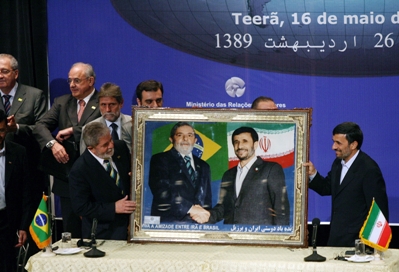
Lula hoped to once again use his good offices and his "relação de amizade" (friendly relationship) to prevail upon his counterparat, the public face of the Teheran Tyranny, Mahmoud Ahmadinejad, by offering political asylum to spare her life.

Terror,Inc. no doubt thanks Lula for the fig leaf on the nuclear front, but soundly rejected him. The Brazilian president was "misinformed" about the case, a spokesperson said.

No one is misinformed about a rogue regime that continues to defy the international community with impunity. Its barbaric and macabre tactics terrorize not only the Iranian people, but others in the world through its Islamic fascist terrorism.

Brazil, an emerging giant on the world stage, should choose its friends more carefully.

Alignment with Terror,Inc. has not redounded positively for Brasilia as evidence by the split now evident in the "friendly relationship."

***
If you need research from open sources in Spanish, French, or Portuguese and presented in a stylish English language report or a translation of documents in said languages to English, please contact Professor Winn at by sending an email to mrenglish101@gmail.com for a prompt evaluation.

Wednesday, May 19, 2010

US Diplomacy in Tatters - Iran Wins Again

 "...as long as the dictatorships exist, war is inevitable, and that it may be better to have war now, when we have an issue that may be supposed to appeal to the whole world, rather than to put it off to some future date when our position may be more difficult and dangerous." -  Statement by Sir Samuel Hoare, Secretary of State for the Home Department, British House of Commons, October 3, 1938 after the Munich Pact

The difficult and dangerous time arrived this week for the United States when its Nato ally Turkey and supposed Latin American friend Brazil provided the Teheran Tyranny a fig leave to continue its drive for nuclear primacy in the Middle East.

As the Heritage Foundation´s blog, The Foundry, notes: "[The agreement] would only deflate the perceived urgency of imposing sanctions on Iran while allowing Tehran to advance its nuclear weapons program with impunity."

Thus, Iran will have nuclear weapons and the ballistic missiles to deliver them to Tel Aviv and Washington. It is astonishing that this is an acceptable toll for Washington to pay.

 The West has failed just as GSM forecast in its Net Assessment: Iran last year.

In the short run, the US Administration´s pusillanimous policy toward Iran, best qualified as "Sanctions or Bust," is at a dead end.

While headlines speak of Russia and China aboard, there is little chance enough UN Security Council members will vote for any sanctions given the Turkey nuclear fuel swap deal.

Some policy wonks actually believe in the Teheran Tyranny´s peaceful intentions. No, Ms. Slavin, Iran cannot deliver on a deal it reneged on before. 

Iran has no peaceful intentions. The Teheran Tyranny has not engaged in deceit, deception, and duplicity to just throw away an expensive public and hidden nuclear program. Terror, Inc. is not building longer-range ballistic missiles for a rainy day.

The rogue regime in Teheran is dead serious in continuing to inflict as much harm as possible against the Israel and the United States and their allies and interests. To believe otherwise is beyond naive.

As a young John F. Kennedy wrote before World War II after the failed Munich Pact:  "Appeasement was, therefore, as I have said, partly based on the mistaken belief that peace might be achieved by concession but it was also a realistic hard-headed policy of playing for time."

For freedom lovers worldwide, that time is nearly up. A nuclear Iran is a game-changer in the global security calculus.

As like Munich, paper-mache charades like the nuclear deal brokered by Turkey and Brazil with the Iranian dictatorship does not prevent war, but make it more certain. 
***

Saturday, November 28, 2009

US on Right Side of Honduran Crisis, finally

 Fledgling US President Obama seems to have a firmer footing in Latin America by supporting the presidential elections in Honduras on Sunday despite rankling some countries in the region, as outlined in
Obama Backing of Honduras Election Crimps Latin Ties.

 The Administration´s first stance supporting the restitution of constitutionally-removed former president Mel Zelaya was incomprehensible. Foreign assistance was cut off and visas were canceled for members of interim President Micheletti´s government.


Slowly Washington evolved its thinking (prodded by US Senator Jim Demint of South Carolina, a member of the powerful Senate Foreign Relations Committee) on the Honduran Crisis by silently rejecting the popular narrative spun by the Castro-Chavez Axis as a ´´coup´´ in another Latin American country. Unfortunately, the international press picked up the line and complicated a sober and honest assessment of the facts on the ground in Tegucigalpa.

No coup occurred when the Honduran Congress and Supreme Court acted to save the country and ordered Zelaya´s removal from the presidency.  The near-coup actually happened when Zelaya rolled the dice in an illegal and naked power grab in a rigged national referendum to perpetuate himself in power. He failed to copy the success of Hugo Chavez in Venezuela and Evo Morales in Bolivia to install competitive autocracy through the ballot box.

As quoted in ''Impasse em Honduras amplia divisão político-ideológica na região''(Impasse in Honduras Widens Ideological Division in Region), Clodoaldo Bueno, a foreign policy professor at the University of São Paulo, believes ''Little by little, other countries will probably end up recognizing the election as the only possible solution because there will not be an ideal one.''


 The Honduran Crisis is more than a tug-o-war of who leads Honduras. The bigger picture is a test of wills between two competing ideologies of Washington and the Castro-Chavez Axis in the region.

The only crimped ''Latin ties'' of importance are with Brazil, Argentina, and Chile. Standing for free elections and democractic values should not be so controversial.

The weight of Washington´s endorsement of the elections should also influence the European Union and individual states to give their unqualified support as well to finally conclude this difficult time for the people of Honduras who have been the first to forestall a Castro-Chavez takeover of their country. 

The United States does need to pay greater attention to its southern border as both China and Iran forge closer ties. Building pluralist civil societies and improving trade relations, like passing the free trade agreement with Colombia, could help countries in the region to decide upon the political and economic model best for them. That is the their decision not populists who want to change the rules of the game once past the ballot box.
***
Anyone interested in English-language services or translations (Sp/Fr/Pt to En) may send an email to mrenglish101@gmail.com for a prompt evaluation of your documents or research request.

Sunday, November 22, 2009

´´Brazil is different´´

Spain´s leading daily in Madrid, El Pais, sports a thorough article on the Brazilian success story in -Brasil, el gigante despierta (´´Brazil: The Giant Awakens´´) this Sunday.

Brazil is different. "Brasil es diferente". Brazil is in ascendancy.

Oil (la gran espoleta ) ´´fuse´´ is fuelling Brazil´s rise to eminence. Brazil hosts the World Cup in 2014, the crown jewel of soccer and the national passion as well as the recently-announced summer Olympics 2016 - both in the strife-torn paradise of Rio de Janeiro.

However, it was not always so. As the article points out, a mediados de los cincuenta importaba el 95% del petróleo que consumía (in the 1950s, it imported 95% of its oil consumed) and now se puede convertir en la sexta región petrolífera del planeta, could become the world´s sixth largest oil producer, a virtual island of stability in contrast to the far-flung and fragile oil sheikdoms in the Middle East.

Indeed, state-run megacorporation Petrobras posted a $4.24 billion profit last quarter in line with market expectations.

On the flipside, 25% of Brazil´s population swelters in poverty, a high rate of violence afflicts its largest cities, and substandard infrastructure and educational systems are difficult obstacles to overcome. The large oil profits accumulated by the state are not reaching the most destitute and less fortunate.


President Lula, a fighter from his union days, can point to at least one success on the macroeconomic level during his two terms in office: Brazil, the largest economy of Latin America, was one of the first countries to emerge from the global economic crisis.

As a powerful developing country with unlimited ambition and a regional heavyweight, on the diplomatic front, Lula drew raised eyebrows by welcoming Iranian President Mahmoud Ahmadinejad this Monday just two weeks after the visit by Isreaeli President Shimon Peres. Mr. Ahmadinejad will also include mutual friends Hugo Chavez of Venezuela and Evo Moraels of Bolivia, two countries at odds with Washington, on his travels to the region.

Perhaps the retiring president believes his good offices could promote peaceful dialogue with a fellow oil producing state. Next year, Brazil chooses a new president as he steps aside.


At the end of the day, despite its internal challenges, Brazil continues to acumula las mayores reservas de optimismo del planeta (accumulates the greatest reseves of optimism on the planet).

Any visitor here can certainly attest to that feeling in the air and among the people.

Monday, November 9, 2009

Honduran Crisis: Recognize Michelleti Now


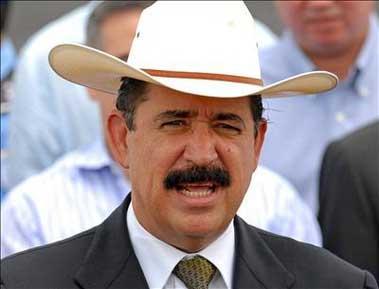
Honduras is no better off after constitutionally-ousted former president of Honduras, Manuel Zelaya, cries foul over a breakdown of the accord leading to his restitution and a national unity government: ´´The accord is dead.´´ 


The accord forced upon the interim President Michelleti by the disgraced OAS calls for a vote by the Honduran Congress and Supreme Court before Zelaya supposedly returns to power. However, the Honduran Congress and Supreme Court voted him out of power, thus sparking the ´´crisis.´´ Just because one is president he or she is not above the law as Mr. Zelaya found out.

There is no evidence Mr. Zelaya has learned a lesson from his constitutional ouster. There is no contrition. Authoritarians rarely say ´´I am sorry.´´ His designs for Honduras to continue as a transhipment point for Venezuelan drug planes and to become a junior member of the Castro-Chavez Club are unaltered.

Thus, Mr. Zelaya is a threat to Honduran democracy. His street thugs agitating for his return at any costs, including attacking the attorney general investigating his alledged long list of crimes last weekend, are very similar to the same outlaws enforcing Chavezism in Venezuela.

Brazil still provides diplomatic cover for Mr. Zelaya housing him in their embassy. The United States first rushed to support him because of ´´coup´´ talk (false).

It is time for regional powers and the international community as a whole to recognize the Micheletti government in Tegucigalpa and recognize Mr. Zelaya was dutifully dismissed and let Honduras resolve its problems alone.

Freedom and democracy are in the balance.

Get your International Policy books today!