Global Security Headlines

Showing posts with label Somalia. Show all posts

Sunday, July 25, 2010

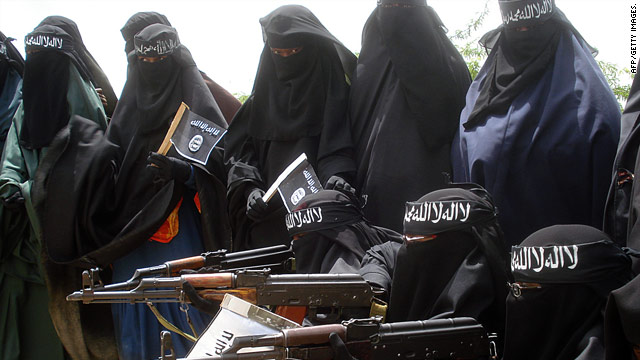
Al Shabaab - cnn.com
Al Qaeda remains a significant and growing threat to global security.

Somali-based Al Shabaab's attack in Kampala, Uganda, following the World Cup final earlier this month is credited by terrorist experts as a play for official membership in the Al Qaeda franchise club.

Uganda was not a random target. Its peacekeepers protect the weak Somali government which Al Shabaab hopes to sack. 

AQIM (Al Qaeda in the Islamic Maghreb-Sahel) operates in Sub-Saharan Africa and poses a direct danger to western Europe. It likes to capture and kill relief workers trying to improve the lives of those trapped in the desolate region.

In Yemen, the UK ambassador and his convoy narrowly survived a suicide bomb attack last April credited to  Al Qaeda in the Arabian Peninsula (AQAP).

AQAP is expanding its reach and scale of operations. In fact it just released its first English-language Inspire magazine for entrepreneurial suicide bombers in order to connect with a worldwide recruitment pool.

Moreover, AQAP is directly tied to the so-called Christmas Day bomber in the United States last year.

While the main Al Qaeda organization is pressured in Iraq, Afghanistan, and Pakistan, start ups and franchises proliferate where lawlessness prevails like in the Sahel, Somalia, and Yemen.

It is clear the West's efforts to control the tide of terror wrought by Islamic fascism is failing.

While the real war is inside Islam, the West is a convenient target both in the minds and in the deeds of militant Islamics as an expression of their fundamentalist rage against the modern world.

***
If you need research from open sources in Spanish, French, or Portuguese and presented in a stylish English language report or a translation of documents in said languages to English, please contact Professor Winn at by sending an email to mrenglish101@gmail.com for a prompt evaluation.

Friday, April 10, 2009

Beating the Pirate Challenge

Proceedings Story - U.S. Naval Institute - "What Makes Piracy Work?"

Dr. Virginia Lunsford provides a fascinating history of African piracy and sensible policy prescriptions to defeat the Somali pirate challenge.

Get your International Policy books today!

Thursday, April 9, 2009

US President Obama's Flunking First Test

credit: BBC

The principle of freedom of the seas has traditionally been a cornerstone of US international policy beginning with the War of 1812 with Great Britain.

As US President Franklin Delano Roosevelt pronounced in May 1941 before later entering World War II:

"All freedom—meaning freedom to live and not freedom to conquer and subjugate other peoples—depends on the freedom of the seas—for our own shipping, for the commerce of our sister Republics, for the right of all nations to use the highways of world trade, and for our own safety…. As President of a united, determined people, I say solemnly: we reassert the ancient American doctrine of the freedom of the seas." (American Foreign Policy Encyclopedia )

The freedom of the seas is paramount to ensuring global security.

Thus, President Obama's silence on the latest pirate attack off the coast of lawless Somalia is curious and appears to be an abandonment of the principle of freedom of seas upheld by his predecessors.

This latest incident comes on the heels of Chinese harassment of a US civilian crewed naval survey vessel last month 70 miles south of Hainan Island.

Statements by Secretary of State Hillary Clinton qualifying the seizure of the American captain of the Maersk Alabama by Somali "outlaws of the ocean" as a "criminal act" is also erroneous. Piracy is more than a crime; it is terrorism on the high seas.

The purposeful misnaming of the attack by the puckish pirates only adds to the mysterious behavior by the Obama Administration facing its first international policy test. The new administration appears to be downplaying the incident despite the increase of US naval forces in the vicinity of the dinghy where the pirates hold the US captain.

The deadening silence from the White House on freedom of the seas raises concerns about the ability of the new US administration to deftly manage international relations given the high principle and US citizen involved. The US military possesses a strategy and is prepared to defend the freedom of the seas.

For the moment, US President Obama is flunking his first international test and more worthy opponents are surely taking note.

Get your International Policy books today!