Global Security Headlines

Showing posts with label Cold War. Show all posts

Wednesday, January 13, 2010

Hitler? A scapegoat. Stalin? I can empathise. Oliver Stone stirs up history | Film | The Guardian

It is dangerous when Hollywood recasts history to fit a film director´s political philosophy.  The Guardian of the UK published a disturbing interview with Oliver Stone as recounted in its story: Hitler? A scapegoat. Stalin? I can empathise. Oliver Stone stirs up history.

One excerpt is a slap at every Allied veteran who faced down the Axis powers, or lost buddies in the at Anzio, Normandy, Battle of the Bulge, and the German massacre at Malmedy.

"Hitler is an easy scapegoat throughout history and it's been used cheaply," he said. Then he mentioned the S word. "Stalin has a complete other story. Not to paint him as a hero, but to tell a more factual representation. He fought the German war machine more than any person."

While Mr. Stone is flipping through history texts for the "proper context" of Adolf Hitler and Joseph Stalin, GSM suggests he include the  Molotov-Ribbentrop Pact (named after the foreign ministers of each respective country) between the USSR and Nazi Germany. The secret protocols of the so-called  Nazi-Soviet Non-Aggression Pact carved up Eastern Europe into spheres of influence and opened up the invasion on Poland just over a week later. An original of the pact was found in Soviet archives in 1992.

Two of the murderous madmen in the twentieth century were partners at the beginning of the war and there was actually negligible difference between the two totalitarian regimes.

Yes, the Soviets now Russians can contend correctly to a point, they bore the brunt of stopping Hitler after Operation Barbarosa, Hitler´s fateful invasion of Russia in June 1941.However, after the Normandy invasion, the US, Britain, Canada, France, and other non-Soviet allies were much closer to Germany. The two front war with the US-led forces in the West and yes, the Soviet Red Army in the East together, doomed a bombed-out Germany reduced to sending old men and children to fight.

It is instructive however to remember Stalin´s initial moral (and strategic) bargain with the devil in Berlin and that he only turned against the "German war machine" after getting over the shock of its invasion of his homeland. An innocent angel he is not.

A "proper context" is how the Allies - the freedom lovers - led by the United States crushed both Nazism and eventually Communism in the Cold War after a titanic struggle lasting 46 years, one of the most significant events in the last century. 

However, Mr. Stone´s study of history, given his past propaganda films, is suspect and only does a disservice to individuals who will never get the "truth" in a public school and too often rely on movies for knowledge, sadly.
***
If you need research from open sources in Spanish, French, or Portuguese and presented in a stylish English language report or a translation of documents in said languages to English, please contact Professor Winn at by sending an email to mrenglish101@gmail.com for a prompt evaluation.

Tuesday, November 10, 2009

Cold War Series Part IV: Lessons Learned


“We win, they lose.” - Ronald Reagan´s strategy for the Cold War


GSM concludes its four part series on the Cold War examining the lessons learned recalling the maxim studying history is to (hopefully) avoid repeating it.

First, a just cause and the will to advance it are key ingredients in a struggle. The Western powers and their allies around the world united their efforts to oppose Soviet-inspired tyranny  Every continent was affected by the East-West contest. Though progress waxed and waned, the thirst for freedom by the oppressed cowering at the boot of the dictator sustained the West´s effort to defeat Soviet communism.


Second, the spiritual aspect of the democracies, especially the appeal in East Europe by the Pope John Paul II in the Vatican, is credited with fueling the Solidarity trade union resistance in his native Poland. Moscow attempted to assassinate the Pope and never underestimated his ability to expose the hollowness of secular communism. The ´´holy alliance´´ between former US President Reagan and former Pope John Paul II proved a potent antidote to the raw atheistic offerings of Soviet communism. Faith to overcome the heavy boot of tyranny sustained many behind the Iron Curtain. In addition, the moral element embodied in Reagan´s ´´evil empire´´ comment drew the battle lines tight with the practitioners of tyranny like Solzhenitsyn´s Gulag Archipelago.

Third, military superiority spearheaded by President Reagan´s military buildup and modernization of strategic weaponry narrowed the gap with the Soviet Union. The military maliase following the Vietnam War defeat, highlighted by the ´disaster in the desert´ to rescue the Iranian-held hostates in 1980, left the United States vulnerable in the air, land, and sea. The buildup demonstrated US resolve at a critical time. The Warsaw Pact held the number superiority, but the West compensated with superior technology.

Fourth, in deed, the technological edge, particularly the mere threat of a Strategic Defense Initiative (derided by the Western press as ´´Star Wars´´) convinced the Soviets to seriously reconsider both the nature of the struggle with the West and the confident Reagan leadership in the White House. The KGB thought the tech gap with the West undermined Moscow´s ability to compete. Reagan doubled down on the costs for the Soviets to compete with the West, essentially to bankrupt Moscow.

Fifth, the ideological economical competition pitted free markets versus Marxism and capitalism won. The Soviet 5-Year plans as required by the command economy were folly. The more productive West despite intermittent cyclical market downturns proved the superior economic system to provide the most basic goods and social mobility for a better life.

Finally, the will to win and overcome cannot be underscored enough. The democracies´ will to win was flagging when former US President Reagan and former British Prime Minister Margaret Thatcher appeared on the scene at a crucial time in world history to dispatch Soviet communism to the ash heap of history. One wins by imposing your will on the opponent. Mr. Reagan and Mrs. Thatcher imposed the West´s will on Mr. Gorbachev who only sought to reform communism instead of killing it. Laurels for Mr. Gorbachev are misguided. His card hand was not very appetizing when he appeared on the scene to preside over the dissolution of the East European dictatorships, a Soviet leader´s nightmare.

The West won and the Soviet Union lost just as Reagan quipped in our quote above. The end of the Cold War was not marked by victory parades or grand displays in contrast to the May Day celebrations in Moscow every year. Regrettably, many in the democracies are unaware of the high stakes involved in the titanic struggle with Moscow and worse, many sympathized if not openly sided with Moscow.

We live in a more dangerous multipolar world today without any longing for the managed bipolar world of the Cold War. Nuclear technology and ballistic missiles are more available around the world in the hands of tyrants. There is no Reagan or Thatcher on the scene in the democracies to confront the scourage of Islamic fascist terrorism, nuclear-tipped tyrants or other asymetrical challenges to freedom and pluralism.

Leaders in the democracies today do good to heed these lessons and apply them forthright or risk horrifying consequences.


Get your International Policy books today!

Saturday, November 7, 2009

Cold War Series Part I: Soviet Communist Ascendancy


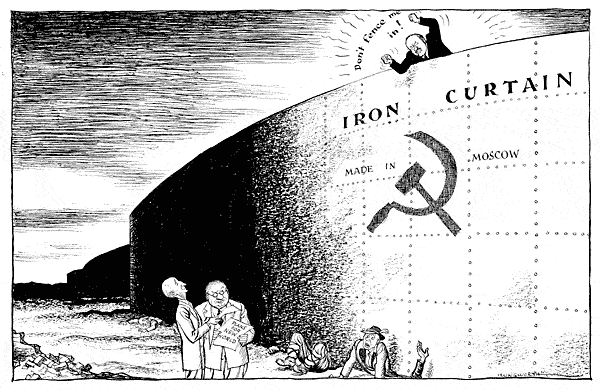
November 9, 2009, marks the 20th anniversary of the fall of the odious Berlin Wall, a symbolic event for ushering in the end of the Cold War. An ´´Iron Curtain,´´ separating East and West Europe, walls, vicious guard dogs, prison camps, barbed wire, minefields, no-mans land, Checkpoint Charlie, and soldiers at the ready were implements of tyrannical regimes to enslave their people, dash their dreams, and maintain total control through the gun barrel.

The Western democracies led by the United States rejected this barbarism.

GSM in a four part series reviews the Cold War. Part I covers the ascendancy of Soviet communism. Part II shows how the Cold War was not won. Part III demonstrates how the West´s iron-willed determination forced Moscow to relent. Finally, Part IV expounds upon the lessons learned which are applicable to the current international system.

 From the ashes of World War II sprang almost immediately the Cold War, the titanic struggle between the West (NATO) and the East (Warsaw Pact). Namely, the United States and the Soviet Union managed a rivalry across the global chessboard for supremacy. Would tyranny and command economics triumph over freedom and market economics? For 46 years, the two sides competed for prestige, allies to carry forward the fight, and of course, victory.

The early contests began in the divided Germany - Federal Republic of Germany (West Germany) and the German Democratic Republic (East Germany) in the former Nazi capital - Berlin. The West led by US President Harry Truman defied Soviet attempts to block land routes into western Berlin (where the western Allies had divided the capital into zones) with a massive airlift transferring supplies to 2.2 million inhabitants. The Soviets did not act to stop the airlift and the crisis abated and West Berlin became an island of freedom and market economics in the heart of East Germany. West Berlin and the divided Germany would be a constant thorn in the side of the Soviet Union throughout the Cold War.

The US-Soviet rivalry stretched across the globe touching every continent. US President Truman believed China´s helped spark the Korean Conflict which was fought to a stalemate. That unsettled conflict precipitated a challenge later in Vietnam where first the French were evicted by a nationalistic communist insurgency and later the United States who left the quagmire with a shameful defeat. The dominoes fell later as predicted in Laos and Cambodia who also fell under communist tyranny. Re-education camps and ´´the killing fields´´of Cambodia proceeded to subject millions to a fate of certain death.

Indeed, the 1970s can arguably be the apogee of Soviet communism. The West was reeling. Many observers believed Moscow´s march was unstoppable and that capitalism was a spent force. At the height of the Arab-Israeli War in 1973, US President Nixon put the country on DEFCON3 (Defense Readiness Condition) to deter the Soviets from intervening.

However deadly serious, the second direct confrontation between Moscow and Washington occurred a decade earlier during the  Cuban Missile Crisis of 1962 which nudged the United States and the Soviet Union closer to mutually assured destruction (MAD). The wily Castro in Havana and reckless Khrushchev in Moscow pushed the US Kennedy Administration to the brink over nuclear missiles in Cuba.

These hot points during the Cold War again redounded to a test of wills. Join us for Part II of our series where we explore how the Cold War was not won. Our final post on the series reflects more on the extraordinary time period the Cold War covered in world history and lessons applicable to global security challenges today.

Get your International Policy books today!