Global Security Headlines

Showing posts with label Taliban. Show all posts

Tuesday, October 27, 2009

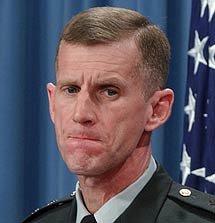
McChrystal´s Decent Interval

White Paper of the Interagency Policy Group's Report on

The United States and its Nato allies are losing the war in rugged Afghanistan against a more rugged foe – the Taliban, the Islamic fascists and former leaders ousted after the US invasion in October 2001 following the 9/11 attacks.


However, the Taliban were never defeated and threaten to retake the country after NatoWhite Paper of the Interagency Policy Group's Report on´s disastrously disjointed and disunited eight-year fight, according to General Stanley A. McChrystal´s bleak assessment.


Delivered at the end of August to US President Barak Hussein Obama, he urgently requested 40,000 more combat troops, a political migraine for his commander-in-chief. So far, the president has punted on any decision.


General McChrystal offers at best his commander-in-chief a decent interval, maybe one to two years of breathing space, in the opinion of GSM, before a precipitous retreat in face of an interminable and insurmountable insurgency. The Western democracies will be overcome by exhaustion in terms of blood and treasure in the end.


In three phases, he hopes to reverse Taliban gains and seize the initiative to improve the security situation or ´´defeating the insurgency is no longer possible.´´Higher casualties (and attendant political costs back home) are expected initially to save the war effort while a second component consists of winning the hearts and minds of the Afghan people.


The ´`Afghanization´´ calls for Nato troops to concentrate on the defending population centers and less reliance on air support for combat missions to reduce deaths of innocent civilians. The general forgoes a major Nato advantage and needlessly jeopardizes the foot soldier who will feel the brunt of hand-to-hand combat without air support.


The McChrystal plan is not a strategy at all. It countermands President Obama´s proudly and publicly pronounced policy goals on March 27, 2009 ´´to disrupt, dismantle and defeat al Qaeda in Pakistan and Afghanistan, and to prevent their return to either country in the future.´´ The announcement came before General McChrystal was appointed and an in-theater assessment could be made. Thus, the president acted naively.


The McChrystal plan only buys time which is usually on the side of the insurgent facing a foreign army in his homeland just like before in Vietnam and like now in Afghanistan.

Saturday, May 9, 2009

Pakistan Reader


Pakistan 'fighting for survival'- BBC

Will the Taliban take over Pakistan and thus get the country's nuclear weapons? The stakes could not be higher for the future course of SW Asia and the world.

Below are capsules and links to authoritative analysis of the tense situation.

Pakistan's 'Existential Threat' Comes From Within - Council on Foreign Relations

"There is a real possibility of a jihadist state emerging in Pakistan sometime in the future. And that has to be one of the worst nightmares American foreign policy could have to deal with."

The Brookings Institute

Pakistan's Nuclear Scenarios: The Risks with Bombing

Michael E. O'Hanlon, May 06, 2009, The New York Times' "Room For Debate"

As the Pakistani military launched a new offensive against the Taliban in the country’s North-West Frontier Province, officials and former officials in Washington continued to discuss what the American response should be to the heightened conflict. Michael O'Hanlon offers his views on the situation.

The Heritage Foundation
May 4, 2009
Backgrounder #2268

Pakistan is in the midst of rapid political shifts that are challenging the leadership's ability to maintain cohesion within the country and even raising ques­tions about Pakistan's ability to survive as a viable nation-state over the next few years. Pakistan has long suffered from ethnic and sectarian divisions. However, the recent threat from a well-armed and well-orga­nized Islamist insurgency pushing to establish strict Islamic law in the entire country, beginning with the North West Frontier Province (NWFP), adds a new and more dangerous dimension to the country's chal­lenges. Although the collapse of the Pakistani state may not be imminent, as some have recently argued, the government's surrender of the Swat Valley is a major victory for Islamist extremists seeking to carve out pockets of influence within the country.