Global Security Headlines

Showing posts with label Berlin. Show all posts

Wednesday, November 11, 2009

Headless in Berlin


Freedom is indivisible, and when one man is enslaved, all are not free.
-  Former US President John F. Kennedy in his Berlin speech, June 1963

The United States was left headless in Berlin last Monday.
 
US President Barak Hussein Obama did not deign to visit the 20th anniversary of the Berlin Wall´s fall for three main reasons. Instead, he dispatched Secretary of State Hillary R. Clinton, a diplomatic downgrade, to mingle with the presidents and prime ministers of US allies in Europe.

It is a despicable act and a shameful behavior by the leader of the free world and president of the very country that forced the hands of the communist dictatorships to surrender leading to fall of the Iron Curtain symbolized by the fall of the odious Berlin Wall twenty years ago. Unfortunately, it is consistent with a US president ill at ease with American success and leadership in the world and devoid of intellectul curiosity about global security.

Tone death to history, US President Barak Hussein Obama betrayed the legacy of his Democrat Party´s main icon in the latter half of the last century,  John F. Kennedy, who proudly stood at the wall and declared: ´´All free men, wherever they may live, are citizens of Berlin, and, therefore, as a free man, I take pride in the words "Ich bin ein Berliner.´´

US President Obama, who is often lauded for his soaring rhetoric, cannot ever match the substance of former President Kennedy nor his committment for freedom, sadly.

Moreover, the Democrat Party was on the wrong side of history seeking more accomodation and less confrontation with the Soviet Union after the US reversal in the Vietnam War. Perhaps President Obama did not want to bring attention to this fact.
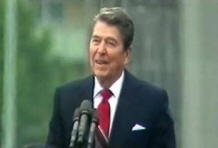

However, the fall of the Berlin Wall is not viewed by many Americans as a partisan achievement while it is undeniable the impetus for forcing the communist dictatorships in Eastern Europe to yield to the thirst for freedom by their people was Ronald Wilson Reagan, a member of the Republican Party, the Democrat´s main political opponent. In June of 1987, former US President Ronald Reagan proclaimed at the Wall:

´´I noticed words crudely spray-painted upon the wall, perhaps by a young Berliner (quote):"This wall will fall. Beliefs become reality." Yes, across Europe, this wall will fall, for it cannot withstand faith; it cannot withstand truth. The wall cannot withstand freedom.´´

Indeed, a little freedom is very dangerous for tyrannical regimes. Liberty cannot be snuffed out by concrete and steel when the will of the people is greater than its dictators.

President Obama´s absence at the anniversary last Monday is a telling indictment on his rank inability to fulfill the august duties of president and serve as the number one advocate defender of freedom, a horrifying combination. Today´s tyrannts may misread the US president´s snub and imperil global security further.

Saturday, November 7, 2009

Cold War Series Part I: Soviet Communist Ascendancy


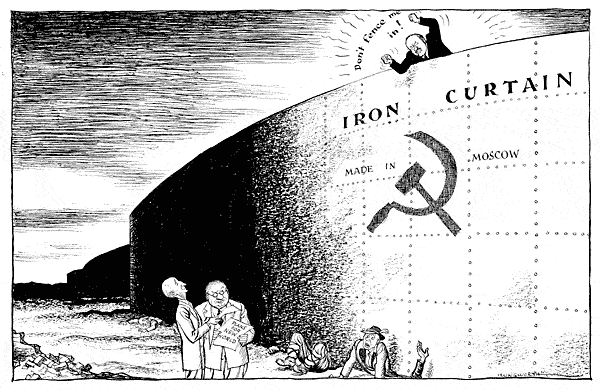
November 9, 2009, marks the 20th anniversary of the fall of the odious Berlin Wall, a symbolic event for ushering in the end of the Cold War. An ´´Iron Curtain,´´ separating East and West Europe, walls, vicious guard dogs, prison camps, barbed wire, minefields, no-mans land, Checkpoint Charlie, and soldiers at the ready were implements of tyrannical regimes to enslave their people, dash their dreams, and maintain total control through the gun barrel.

The Western democracies led by the United States rejected this barbarism.

GSM in a four part series reviews the Cold War. Part I covers the ascendancy of Soviet communism. Part II shows how the Cold War was not won. Part III demonstrates how the West´s iron-willed determination forced Moscow to relent. Finally, Part IV expounds upon the lessons learned which are applicable to the current international system.

 From the ashes of World War II sprang almost immediately the Cold War, the titanic struggle between the West (NATO) and the East (Warsaw Pact). Namely, the United States and the Soviet Union managed a rivalry across the global chessboard for supremacy. Would tyranny and command economics triumph over freedom and market economics? For 46 years, the two sides competed for prestige, allies to carry forward the fight, and of course, victory.

The early contests began in the divided Germany - Federal Republic of Germany (West Germany) and the German Democratic Republic (East Germany) in the former Nazi capital - Berlin. The West led by US President Harry Truman defied Soviet attempts to block land routes into western Berlin (where the western Allies had divided the capital into zones) with a massive airlift transferring supplies to 2.2 million inhabitants. The Soviets did not act to stop the airlift and the crisis abated and West Berlin became an island of freedom and market economics in the heart of East Germany. West Berlin and the divided Germany would be a constant thorn in the side of the Soviet Union throughout the Cold War.

The US-Soviet rivalry stretched across the globe touching every continent. US President Truman believed China´s helped spark the Korean Conflict which was fought to a stalemate. That unsettled conflict precipitated a challenge later in Vietnam where first the French were evicted by a nationalistic communist insurgency and later the United States who left the quagmire with a shameful defeat. The dominoes fell later as predicted in Laos and Cambodia who also fell under communist tyranny. Re-education camps and ´´the killing fields´´of Cambodia proceeded to subject millions to a fate of certain death.

Indeed, the 1970s can arguably be the apogee of Soviet communism. The West was reeling. Many observers believed Moscow´s march was unstoppable and that capitalism was a spent force. At the height of the Arab-Israeli War in 1973, US President Nixon put the country on DEFCON3 (Defense Readiness Condition) to deter the Soviets from intervening.

However deadly serious, the second direct confrontation between Moscow and Washington occurred a decade earlier during the  Cuban Missile Crisis of 1962 which nudged the United States and the Soviet Union closer to mutually assured destruction (MAD). The wily Castro in Havana and reckless Khrushchev in Moscow pushed the US Kennedy Administration to the brink over nuclear missiles in Cuba.

These hot points during the Cold War again redounded to a test of wills. Join us for Part II of our series where we explore how the Cold War was not won. Our final post on the series reflects more on the extraordinary time period the Cold War covered in world history and lessons applicable to global security challenges today.

Get your International Policy books today!