Global Security Headlines

Showing posts with label Ballistic Missiles. Show all posts

Monday, January 3, 2011

Chinese Missile Buildup - Opportunity or Threat?

Three countries worry policymakers the most in Western capitals: China, North Korea, and Iran.  The first two have nuclear weapons and the latter is in hot pursuit.

All three are proliferators of missile and nuclear technology to some degree. China and Iran seek to dominate their respective regions at the expense of US power.

China's many objectives, one focus
An important article last weekend in the Washington Post tackles China's conventional missile buildup: Why China's missiles should be our focus.

Authors Mark Stokes and Dan Blumenthal see the New START ratified by the US Senate last December as misguided given Beijing's conventional short and intermediate-range ballistic and cruise missiles.

Beijing benefits as a non-signatory of the US-Russian INF (Intermediate Nuclear Forces) Treaty from the Cold War.

That China is building military power commensurate with its growing economic power is not news. While intense debate centers upon Beijing's many objectives, an ''overriding'' focus remains reunification with Taiwan.

Missile Manipulation
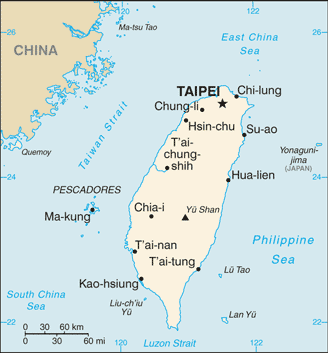
China's most aggressive missile program in the world threatens the East Asian power calculus. The article lists the multifaceted missile program. (see an Economist.com graphic)

Its over 1,200 short-range missiles are aimed squarely at manipulating and recapturing the ''renegade province,'' Taiwan.

Its long and intermediate-range ballistic and cruise missiles advance an anti-access/denial strategy to deter any US defense of Taiwan given Washington's formal commitment to Taipei.

In particular, Beijing's DF-21D anti-ship ballistic missile (ASBM), the so-called ''carrier killer'' concerns defense planners.

For decades, China has pursued a gambit to use land-based missiles to threaten targets at sea.

Implications
The Chinese missile buildup is an opportunity to soberly size up its existential threat to the Western Pacific, home for two of the world's largest economies and strategic choke points.

The credibility of the US commitment to Taiwan is under strain as China's Second Artillery intends to intimidate neighbors (India and Japan) and drive the US out of the region.

The arrival of the Asian century, China's rise to global power status, and relative US decline portend seismic shifts in global security.

It is time for Realpolitik approaches by freedom-loving states to counter the emerging military threats from the China challenge to the tense peace in the region today.
***
If you need research from open sources in Spanish, French, or Portuguese and presented in a stylish English language report or a translation of documents in said languages to English, please contact Professor Winn at by sending an email to mrenglish101@gmail.com for a prompt evaluation.

Friday, July 2, 2010

Russian Spy Caper Imperils START Ratification

Capitol Hill newspaper The Hill reports the following online today: Russian spy ring may be last straw for Obama nuclear arms treaty.

While the Obama Adminstration refused to condemn Russia over the spy caper, in the US Senate, where the START Treaty must gain approval, bipartisan worries could endanger its ratification.

The aggressive cuts in the US nuclear arsenal without any strategic rationale have long concerned GSM.

There are numerous grounds to seriously stall any consideration of the treaty.

Finally, maybe even by accident, the flawed treaty reaches an unglorious end.
***
If you need research from open sources in Spanish, French, or Portuguese and presented in a stylish English language report or a translation of documents in said languages to English, please contact Professor Winn at by sending an email to wtglobalanalytica@gmail.com for a prompt evaluation.

Wednesday, June 30, 2010

Iran Moves Headlong with Nuke Plans

Why is there so much handwringing in the global security community about Iran´s "intentions?"

The Teheran Tyranny´s intentions are clear - Nukes now and Nukes forever!

Terror, Inc.  has not engaged in deceit, deception, and duplicity to just one day roll over and throw away its nuclear capability (and its long-range missile project to deliver its warheads).

While the elected have the luxury to ignore their military chiefs, US Joint Chiefs of Staff Mullen has a duty to worry and he seems convinced Iran is not going to stop its drive for nuclear primacy as reported by Global Security Newswire in Mullen Sees Iranian Nuke Drive Persisting.

GSM has been consistent in its belief that the Teheran Tyranny is a clear and present danger to global security and no measures short of threatening regime survival will dissuade Iran from its dangerous nuclear gambit.
***
If you need research from open sources in Spanish, French, or Portuguese and presented in a stylish English language report or a translation of documents in said languages to English, please contact Professor Winn at by sending an email to wtglobalanalytica@gmail.com for a prompt evaluation.

Wednesday, May 19, 2010

US Diplomacy in Tatters - Iran Wins Again

 "...as long as the dictatorships exist, war is inevitable, and that it may be better to have war now, when we have an issue that may be supposed to appeal to the whole world, rather than to put it off to some future date when our position may be more difficult and dangerous." -  Statement by Sir Samuel Hoare, Secretary of State for the Home Department, British House of Commons, October 3, 1938 after the Munich Pact

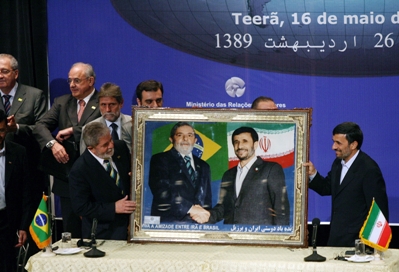
The difficult and dangerous time arrived this week for the United States when its Nato ally Turkey and supposed Latin American friend Brazil provided the Teheran Tyranny a fig leave to continue its drive for nuclear primacy in the Middle East.

As the Heritage Foundation´s blog, The Foundry, notes: "[The agreement] would only deflate the perceived urgency of imposing sanctions on Iran while allowing Tehran to advance its nuclear weapons program with impunity."

Thus, Iran will have nuclear weapons and the ballistic missiles to deliver them to Tel Aviv and Washington. It is astonishing that this is an acceptable toll for Washington to pay.

 The West has failed just as GSM forecast in its Net Assessment: Iran last year.

In the short run, the US Administration´s pusillanimous policy toward Iran, best qualified as "Sanctions or Bust," is at a dead end.

While headlines speak of Russia and China aboard, there is little chance enough UN Security Council members will vote for any sanctions given the Turkey nuclear fuel swap deal.

Some policy wonks actually believe in the Teheran Tyranny´s peaceful intentions. No, Ms. Slavin, Iran cannot deliver on a deal it reneged on before. 

Iran has no peaceful intentions. The Teheran Tyranny has not engaged in deceit, deception, and duplicity to just throw away an expensive public and hidden nuclear program. Terror, Inc. is not building longer-range ballistic missiles for a rainy day.

The rogue regime in Teheran is dead serious in continuing to inflict as much harm as possible against the Israel and the United States and their allies and interests. To believe otherwise is beyond naive.

As a young John F. Kennedy wrote before World War II after the failed Munich Pact:  "Appeasement was, therefore, as I have said, partly based on the mistaken belief that peace might be achieved by concession but it was also a realistic hard-headed policy of playing for time."

For freedom lovers worldwide, that time is nearly up. A nuclear Iran is a game-changer in the global security calculus.

As like Munich, paper-mache charades like the nuclear deal brokered by Turkey and Brazil with the Iranian dictatorship does not prevent war, but make it more certain. 
***

Saturday, January 23, 2010

Obama Comment on Iran in Time Interview


Mr. Obama´s one year anniversary interview with Time Magazine made headlines worldwide with his comments on how he underestimated the difficulty of the so-called MidEast peace process. While dangerous to telegraph your intellectual vacuousness to your enemies, it is not news now. America´s enemies know very well they have a pacifist in the White House.

However, it is his comments on Iran that are more worthy of exploration:

Excerpt 1
 On Iran, one of our trickiest foreign policy challenges, we have held the international community together, both in our engagement strategy, but also now as we move into a dual-track approach. Which is, If they don't accept the open hand, we've got to make sure they understand there are consequences for breaking international rules. 

Iran is not tricky. Terror, Inc. is pursuing nuclear weapons and ballistic missiles to blast Israeli and American cities. Is that tricky? The president needs to be forthright with the American people.

Iran slapped that extended hand, Mr. Obama and you have done nothing as a result. There is no consequence saying NO to the US while you are in the White House. The only "dual-track approach" (trying to sound so smart) is if  Iran breaks an arbitrary pre-determined deadline (like the last one at the end of 2009 of which you are silent and hope no one remembers) is to issue meaningless paper-based threats with no plan to back them up with military force - the only response totalitarian states respect. International rules? (Back to your lawyer training!)

The Iranian nuclear program and long-range missiles are geared for Tel Aviv and Washington. It is American rules Teheran breaks! Iran is a clear and present danger to the United States of America and you are clueless in face of the danger.

International rules are only valid if there is one nation or a group of nations who act to enforce them. However, that requires tough decisions and we already know how tough the MidEast is for you. Lawyers make lousy presidents and worse foreign policy practitioners. The Hobbesian international system is messier than a civil or criminal trial in a US courtroom. The sooner you learn that fact the better you will be.

Excerpt 2
 It's going to be tough, but I think the relationship we've developed with Russia will be very helpful. The outreach we've done to our traditional NATO allies will be very helpful. The work that we've done with China — including the work we've done with China to enforce sanctions against North Korea — will help us in dealing more effectively with Iran.

Sunday, January 3, 2010

US Gives Iran More Chances

I suppose the United States is not too proud (or powerful) to beg as evidenced by this article in the New York Times: U.S. Sees an Opportunity to Press Iran on Nuclear Fuel.

Please, please Teheran...Sanctions are an excuse to avoid facing the real issue and do not work. 

The Western powers' "engagement" with Iran throughout the last two decades is littered with deadlines given to and deadlines passed by Iran. Teheran is an expert at this game by now, however deadly the game is. Even a play of Web 2.0 Social Media in a YouTube message for the Iranian New Year did not affect them.


The West issued deadlines. Iran continued to build it military-civilian nuclear program and tested ballistic missiles with ever greater ranges.

Going Forward
Now in 2010, Iran can reach southern Europe and eventually all of Europe and the "Great Satan," the United States. The US military is already simulating an Iranian attack after the last Sajjil-2 missile test.

Teheran is happy to play the game of more chances until the day arrives when the West´s chances to stop Iran are gone.

Related Post: Net Assessment: Iran.

***
If you need expert research in Spanish, Portuguese, or French to English or translations of documents in said languages, please contact Professor Winn at mrenglish101@gmail.com.

Monday, November 9, 2009

Cold War Series - Part III: How the Cold War Was Won


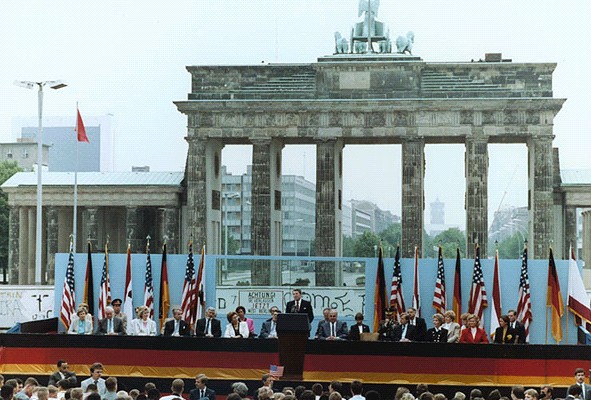
´´General Secretary Gorbachev, if you seek peace, if you seek prosperity for the Soviet Union and Eastern Europe, if you seek liberalization: Come here to this gate! Mr. Gorbachev, open this gate! Mr. Gorbachev, tear down this wall!´´
-
Former US President Ronald W. Reagan, June 12, 1987.

In the end, the Cold War was won by defeating the Soviet Union, a novel concept.

In arguably the West´s darkest moment, Ronald Wilson Reagan, a former actor and governor of California, and Margaret Thatcher, the daughter of a humble grocery store owner, were elected president of the United States (1980) and prime minister of the United Kingdom (1979) respectively. This dynamic duo would steer the West to victory against tyranny.

In 1980, the United States was reeling from twin humiliating reversals: the ghosts of Vietnam and the 444-day hostage drama at the hands of Islamic Republic of Iran, both inflation and unemployment were in double digits and above all US morale was flagging. The Soviets had invaded Afghanistan and the strategic balance in Europe favored Moscow with its deployment of mobile SS-20 missiles. The challenge was cast. Washington and London readily accepted.


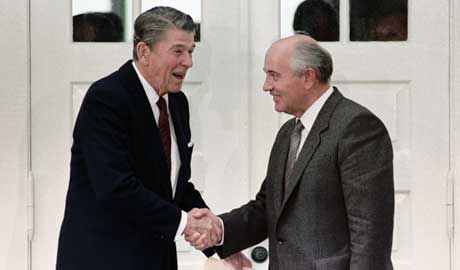
US President Reagan defied the ruckus of KGB-funded peace movement in West Europe and deployed Pershing II and cruise missiles throughout Nato countries to counter the Soviet threat. He finally had a summit with Mikhail Gorbachev in Reykjavik, Iceland, after a series of Soviet leaders died in office over what became the INF (Intermediate Nuclear Forces) Treaty to scrap these missiles.

In a departure from past negotiations, Reagan negotiated from strength: the largest military buildup since Vietnam and an ace in the hole - the Strategic Defense Initiative (SDI) derided by the naive Western news media as ´´Star Wars´´ to discount its realistic function and purpose - creating a missile shield to protect the West from Soviet missiles. His vision then is still inspiring today.

Mr. Gorbachev knew the danger SDI posed to Moscow. The technological gap persisted throughout the Cold War after the Soviets launched Sputnik first in expanding competition into space. The introduction of anti-aircraft missiles in Afghanistan and the rugged mujahideen created the ´´Soviet Vietnam.´´ His perestroika (restructuring) and glasnost (opening) policies lulled the naive Western media, but they were futile attempts to reform and save communism from the dustbin of history. His hand was forced by SDI and the iron will of mainly Reagan and Thatcher backed by credible military force to end the communist menace. Any credit to Mr. Gorbachev is in recognizing the defeat of the Soviet Union.

In the end, visionary leaders, iron nerve backed by strength, and technology gave a strong push to cause the ailing Soviet Union to fail and condemn its brand of communism to the deathbed.


Get your International Policy books today!

Sunday, November 1, 2009

Persian Peril Percolates While West Wanes


"J'espère que ces négociations vont se poursuivre, que les éléments sataniques ne pourront pas les perturber, car le régime sioniste et les puissances dominatrices sont mécontents", a déclaré le président iranien, selon Isna.


´´I hope these negotiations continue [and] that the Satanic forces will not be able to disrupt them because the Zionist regime and domineering powers are dissatisfied.´´

´´Washington is expected to continue to engage Tehran toward a deal on Iran's nuclear program, according to both government sources and American sources accompanying U.S. Secretary of State Hillary Clinton on her lightning visit to Israel Saturday´´ - Haaretz.com, 11/01/2009

´´Iran must demonstrate through concrete steps that it will live up to its responsibilities with regard to its nuclear program.´´ - US President Obama, 10/02/2009 after P-5+1 talks in Geneva.

The Teheran Tyrants know they have won. Iran skipped providing an answer by the October 23 deadline on the ridiculous nuclear enrichment deal. More defiance from the Teheran Tyrants and yet the Obama Administration reportedly (from Haaretz above) is still on the talk-a-thon track. Incredible!

The Western powers at this late date face two unpalatable options: 1) worthless sanctions and 2) a military campaign to cripple Teheran´s nuclear capabilities. The first option is more likely because the United States led by President Obama has no intellectual curiosity about how the world actually works and worse anyone in the his inner circle who does.

A military campaign is fraught with complexity and difficulty given the extensive layout of Iran´s nuclear facilities across the Persian state and the built-in redundancy. It would require a sustained operation to be effective. The repercussions with Russia and China have to be weighed beforehand as well.

When the Bush Administration did not follow up Iraq with confronting Iran more forcefully (as if killing US soldiers in Iraq was not an act of war), the mullahs in Teheran knew the coast was clear. An inexperienced president from a traditionally anti-war (Democrat) party was manna from heaven after the 2008 US elections.

World history is replete with examples when a determined foe is not confronted until the last hour. It is incredible to believe suddenly Iran will scrap its crown jewel overnight to please the Western powers after investing billions of oil dollars in research, materiel, nuclear scientists, and advanced ballistic missiles to deliver their lethal cargo.

Its protectors in the proxy war with the United States, Russia and China namely, provide Teheran the cover required to defy Washington. The smart bet is to believe the naive US president does not have the temerity to launch and all-out military assault given his mounting domestic worries including sinking poll ratings. Leaders buck polls and do what is required regardless, a profile in courage the current president lacks.

As neighboring Afghanistan and Pakistan teeter on the brink, Iran´s defiance cannot be welcome in Washington. Thus the Persian peril percolates while the West wanes in both influence and credibility in global security affairs.

Tuesday, September 29, 2009

Road to Hell through Geneva

The road to hell is paved with good intentions.

The civilized world is trundling along the road to hell at full speed in its confrontation, or to be nice, mild disagreement, with Iran´s quest for nuclear primacy.

No one wants to offend the Teheran tyrants. They may get mad.

Tomorrow in Geneva, Switzerland, while President Obama curiously in Copenhagen presses the more important issue of 2016 Olympic games in Chicago, he sends US diplomats on a fool´s errand to talk, talk, talk and talk again with Iran over its nuclear program.

The Teheran tyrants have already warned ahead of the tête-a-tête: Don´t press us on nukes!

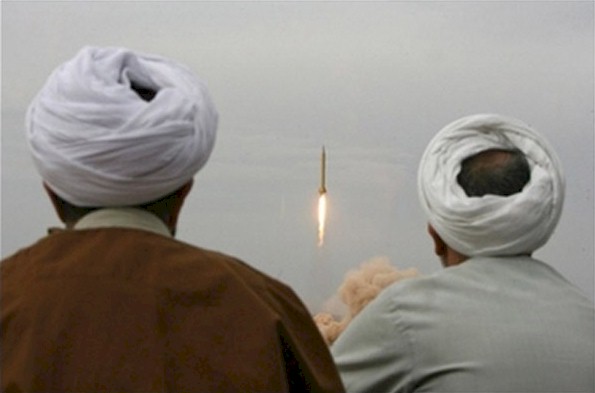
Iran test fired its mid-range Shahab-3 and Sajjil missiles again to punctuate its defiance of the Western powers, namely, the US. While US President Obama extends the olive branch, Iran chops it off with a hatchet.

So, what will the diplomats from the US, UK, France, China, Russia, and Iran discuss in Geneva?

The EU-3 - the UK, France, and Germany - fruitlessly talked with Iran during the 1990s and the Teheran tyrants continued to build their nuclear program and perfect their ballistic missiles systems.

The current Islamic Republic of Iran represents a clear and present danger to global security. Nuclear warheads on ballistic missiles under the control of the Teheran tyrants are inadmissable.

Time for talk is nigh. Time for action is staring the responsible world powers in their eyes.

Sunday, June 14, 2009

Iran and North Korea: Twin Global Security Challenges

Iran and North Korea: Two Sides of the Same Coin


"So the principles of warfare are:

Do not depend on the enemy not coming, but depend on our readiness against him.

Do not depend on the enemy not attacking, but depend on our position that cannot be attacked."

Sun Tzu, Chinese military thinker


Events this month have confirmed Global Security Monitor's fears about the pressing twin challenges to the current global order: Iran and North Korea.

Friday's sham election in Iran (Mahmoud Ahmadinejad' s "victory") and the effrontery of North Korea (threats of nuclear attack) since its apparently successful long-range missile test earlier this month ratchet up the possibility of spiraling crises with a potentially catastrophic endgame.

Global Security Monitor maintains intercontinental ballistic missile capability and nuclear arms in the hands of rogue regimes Iran and North Korea together make a cataclysmic cocktail.

The flaccid response by the fledgling Obama administration in Washington only encourages Tehran and Pyongyang's aggression. Blind optimism cannot temper blind ambition.

Immobilizing the enemy without war, wrote Sun Tzu, is the greatest military feat.

Every day the global community delays in confronting the twin global challenges of Iran and North Korea raises the costs of doing so and edges the world closer to a nuclear disaster.

Sunday, April 12, 2009

Israel’s Iran Dilemma by S. Samuel C. Rajiv

credit: AFP - Israeli Arrow Interceptor Missile Launch

Israel’s Iran Dilemma by S. Samuel C. Rajiv

Mr. Rajiv at India's Institute for Defence Studies and Analyses (IDSA) lays out in frank terms the dilemma Israel faces in countering the budding Iranian nuclear missile challenge.

As the new US president extends the olive branch to his country's longtime foe, and Iran's leader boasts of centrifuges and unwillingness to halt the march toward nuclear weaponry, analysts wonder about the next moves of the new Israeli prime minister.

Is deterrence enough? Does Israel have the necessary supplies to project "extended deterrence?"

Mr. Rajiv methodically examines Jerusalem's limited options.

Get your International Policy books today!

Sunday, March 29, 2009

RFI - Iranian Military Experts in Pyongyang

credit: RFI


Translation Courtesy: Buenos Aires Translator - Professor Winn

NOTE: Professor Winn is a trained observer of international relations and certified translator. These unique skills provide his loyal readers expanded insights distinct from other global security blogs.

Analysis: While the article dismisses the Iranian-North Korean linkage as fitting former US President's "axle of evil," this linkage is precisely what worries global security observers no matter the historical ties between the two countries.


Iran is assisting North Korea perfect its ballistic missile technology. These two rogue nations are negative regional actors, but their technological gains propose wider global security challenges given the increasing range of their missiles.

The proliferation of ballistic missile technology wedded with nuclear ambitions is a deadly combination in the hands of unstable leaders in Tehran and Pyongyang.

The world waits to see just how much Iran has helped North Korea improve its "satellite launch" program. The anticipated early April launch is only a few days away.

Translated Article from the original French

RFI - Des experts militaires iraniens à Pyongyang

Iran/ North Korea
Iranian military experts in Pyongyang

by RFI

Article published 03/29/2009 Last updated on 03/29/2009 at 10:36 UT

Iranian experts are in North Korea to assist the April launch of a “satellite” according to Pyongyang and a disguised missile by the United States, Japan, and South Korea, reports the Japanese newspaper, Sankei Shimbun, on Sunday, citing anonymous sources. Fifteen Iranian missile technology experts arrived in North Korea in early March carrying a letter from the Iranian president to the North Korean leader.

On February 2, Iran placed its first satellite into orbit with its Safir-2 rocket, fuelling Western worries that Tehran would use the technology to develop its ballistic missile program. (Photo: Reuters)

On February 2, Iran placed its first satellite into orbit with its Safir-2 rocket, fuelling Western worries that Tehran would use the technology to develop its ballistic missile program. (Photo: Reuters)
(Photo: Reuters)

If Mahmoud Ahmadinejad wrote Kim Jong-il, it is does signal George Bush’s axis of evil, but underscores the important cooperation between the two countries in the fields of ballistic missiles and space. Iran and North Korea have worked together in these fields for more than 20 years.

Since the 1980s, Iran showed interest in the North Korean Hwaseong-5, nothing more than an improvement on the Soviet Scud. In June 1987 at the end of the Iran-Iraq War, Tehran bought 100 for $500 million. It was renamed Shahab-1 in Iran with a range of 300 kilometers.

In 1993, North Korea prepared a new missile : the Rodong-1 with a range of 1,500 kilometers. In March, Iranian General Mantequei, head of the Revolution’s guided missile program, was invited for its test. Delighted, Iran bought 150 Rodongs and renamed them Shahab-2 and Shahab-3.

At the time, Tehran was not just satisfied with buying North Korean technology. Iranian engineers developed their own ballistic missiles with oil dollars. North Korea was not their only seller and they soon overtook their client.

Today Iran is more advanced than North Korea. Mahmoud Ahmadinejad takes pride in recently launching a satellite into space. Iranians are assisting North Korea launch its much-touted Taepodong-2 missile with a supposed range of 6,700 kilometers.

***
Translation Courtesy: Buenos Aires Translator, Professor Winn

Please contact Professor Winn for translations (Spanish/French/Portuguese >English) via email (mrenglish101@gmail.com) for prompt evaluation.

Saturday, March 28, 2009

Japón y EEUU, en alerta máxima por cohete de Corea del Norte | CaracolTV.com

Translation Courtesy: Buenos Aires Translator

Japón y EEUU, en alerta máxima por cohete de Corea del Norte | CaracolTV.com

Japan and US on maximum alert for North Korean Missile

Las dos potencias no están dispuestas a quedarse de brazos cruzados mientras Pyongyang se apresta a lanzar el supuesto cohete. Por eso, la primera movilizó dos buques militares capaces de interceptar misiles y la segunda alista otras dos naves destructoras. ¿Conflicto armado a la vista?

The two powers are not sitting with their arms crossed while Pyongyang readies to launch its reported rocket. In this regard, the former mobilized two missile interceptor vessles and the latter two naval destroyers. Is armed conflict near?

Corea del Norte anunció que lanzará un satélite de comunicaciones entre el 4 y el 8 de abril, pero las potencias regionales creen que será una prueba de su misil de largo alcance, el Taepodong-2, que ya estaría en la plataforma de lanzamiento en una base.

North Korea said it will launch a communications satellite between April 4 and 8, but the regional powers believe the long-range missile test of the Taepodong-2 could already be on a base launch pad.

****
Test of Wills, Credibility

Pyongy
ang insists in being first to challenge the young Obama administration in Washington.

The test of wills between the two capitals is more than an academic exercise for both US foes and friends alike. Japan, a stalwart Asian ally, now has Patriot missile batteries surrounding Tokyo just in case.

Given the untested president, US credibility not only in Asia but worldwide hangs in the balance the stakes are so high.

Media reports diffused in different languages communicate explicitly Washington and Tokyo's resolve to counter any Pyongyang chicanery.

US in Range


The Taepodong-2, a two or three-stage rocket with a range of over 4,000 miles, could hit Alaska while a US admiral also includes Hawaii, where President Obama spent his formative years.

While analysts at Global Security Monitor are certain Pyongyang is aware of the "red lines" set by Washington to what constitutes a "pull the ripcord" moment, it is not abundantly clear North Korea cares. credit: AFP

Given North Korea's technical difficulties with the Taepedong (the last test failed in 2006), a safer scenario for global security is another launch pad "accident."

While the immediate crisis would pass, the persistent problem of a starving hermit regime armed to the teeth across
from the DMZ menacing an important US ally, South Korea, and disturbing NE Asia peace, would remain in its wake.

Thursday, March 26, 2009

North Korea readies missile, makes new threat


North Korea readies missile, makes new threat

3...2...1...Countdown to Confrontation

North Korea appears impervious to external pressure. Its early April satellite launch (which also tests ballistic missile launch capability) nears without any sign of flexibility from Pyongyang.

Despite the warnings of more UN sanctions (dubious effectiveness given the extent North Korea is already disconnected from the global community) and the presence of US naval vessels offshore to shoot down the missile if ordered, Pyongyang nears the point of no return in its deadly serious cat-and-mouse game with its Six Party Talk states (US, China, Russia, Japan, South Korea).

Another rogue regime disturbs regional security with wider implications for global security. The countdown to confrontation with North Korea advances unabated.

If you are in Buenos Aires and want English lessons personally designed to fit your needs, please call Professor Winn at 1160 461 342 or send an email to mrenglish101@gmail.com.

Anyone interested in English-language services or translations (Sp/Fr/Pt>En) may send an email to mrenglish101@gmail.com for a prompt evaluation.

Buy your English-language texts today!

Monday, March 16, 2009

North Korea I: Clear and Present Danger to Global Security

Dangerous DPRK

The Democratic People's Republic of Korea (DPRK) a/k/a North Korea is another clear and present danger to global security like Iran. The nuclear genie out of the bottle worries global security planners and observers alike.

North Korea is nuclear and is testing long-range missiles to deliver these payloads while sharing (selling) its technology with other pariah regimes across the globe like a nuclear reactor in Syria.

Who leads the DPRK?

The DPRK is a mysterious country cloaked in secrecy, opaqueness, and intrigue. Its Juche philosophy - extreme self-reliance and sacrifice for the North Korean state - remains its guiding body of principles. After the collapse of the Soviet Union, Pyonyang has become more militarily bellicose and politically isolated.

An apparent ailing Kim Jong-il has sparked a leadership crisis for the regime amidst its confrontation with its neighbors and the US over its nuclear program. Its economy is moribund. The populace "continues to suffer from prolonged malnutrition and poor living conditions." Its military, winner of most state resources, is poised to unleash a scorching artillery and missile barrage on South Korea and overrun its familiar nation.

What next for the DPRK?

A wounded animal fights to the death. The DPRK is spiraling downward for either a hard or soft landing. Its fragility however is no reason to recoil from the difficult task ahead. Our next post examines the military situation on the Korean peninsula and in our third post we discuss the red lines for a policy cracking the Korean chestnut that vexes global security policy makers.

Get your International Policy books today!

Tuesday, February 3, 2009

Tehran to World: "Shah Mat"

credit: IRNA

Triumphantly celebrating the occasion of its 30 years of revolution, Iranian grand master Ehsan Qaem-Maqami beat former Russian World Champion Anatoly Karpov in the old Persian game of chess on Monday.

However, President Mahmoud Ahmadinejad has the true pleasure in declaring "Checkmate!" (Shah Mat) to the world community in hailing the successful launch of a rudimentary communication satellite using the Safir-2 rocket later in the evening.

So, to the forlorn meeting on Wednesday in Frankfurt of the so-called " 5 Plus 1" Group (United States, United Kingdom, France, Russia, and China plus Germany), Iran sends its emissary (Safir) - a rocket launch - right in your face.

Russia apparently will not attend dooming the discussion about the Iranian nuclear program and leaving the Western powers to chat among themselves. While chatting, Tehran plans its next three moves in the complex chess match with the international community.

Significant Satellite Launch

The significance of the successful satellite launch (video) cannot be discounted. Iran joins the elite list of now 11 countries that have done so. National pride to satiate internal regime critics is very valuable to President Ahmadinejad.

However, the satellite is not the issue. The capability of shooting a payload and the type of payload into the heavens are.

Despite strict international sanctions to blunt such activity, the Iranian breakout as discussed in my previous post continues with the latest launch. Obviously economic sanctions have failed to deter Tehran.

The next firing of a missile could carry a nuclear warhead. Indeed, a satellite launch vehicle (SLV) is required infrastructure and technology to lob a projectile anywhere in the world - the scariest result of Tehran's latest technical demonstration.

Shah Mat

Tehran is not moved by diplomatic discussions, deterred by economic sanctions, or fearful of any military moves by the international community.

The Western powers have no will to challenge Iran directly.

Russia and China have interlocking political, economic, and military goals in concert with Tehran's steely-eyed defiance of its enemy number one, the United States. Iran is their proud proxy to challenge perceived US hegemony.

Any confrontation with Tehran risks also consequences with Moscow and Beijing. That point cannot be underestimated in the policy calculus. Moscow's skipping the Group Plus 1 talks is telling.

Going Forward

Those countries who oppose Iran's date with its nuclear destiny are checkmated. No incentives short of regime change in Tehran amuse the ruling elite.

As soon as the international community understands that point, the sooner a resolution of the Iranian issue can be had.

Sunday, January 25, 2009

Iran Presents Clear and Present Danger


credit: Missile Defense Advocacy

Iran is a clear and present danger to the international community on five fronts.

First, Iran is expected to acquire enough nuclear enriched material to build its first atomic later this year, if not earlier. A nuclear Iran dramatically changes the security dynamics in the entire Middle East.

Second, Iran gladly shares its resources with other negative forces in the global community from nation-states to client groups serving as proxies to effect Iranian foreign policy. For example, Hezbollah, Hamas, and Al Quayda receive generous support from Tehran which leads to our next point.

Third, Tehran is Terror, Inc. Terrorism is a natural extension of Iran's foreign policy. Even the US State Department concedes Iran is an active state sponsor of terrorism.

Fourth, Iran has ballistic missiles (Shahab 3) thanks to China and North Korea. Worse, its latest iteration, the Sijil, reportedly places southern Europe within the shadow of Tehran with its range of 1200 miles. The Sijil is a purportedly a two-stage solid-fuel rocket only adding to its lethality. The marriage of Iran's ambitious nuclear and ballistic missile programs is a nightmare for its regional neighbors and now the continent of Europe. However, Iran reserves it main ire for the continental United States.

Lastly and perhaps more frighteningly, Iranian President Ahmadinejad's statements suggest his following of the apocalyptic belief in the Twelfth Imam, Muhammad al-Mahdi. Shiites believe the "Hidden Imam" will return to forever end the struggle between good and evil and signal the End of Time. Mr. Ahmadinejad tasks himself to to prepare the world for the return. Such a messianic vision atop of a nuclearized terror state is enough to ring alarm bells in world capitals from Riyadh to Reykjavik.

The Iranian issue facing the global community could possibly redound very ugly. Actions taken and not at this moment impact profoundly near term global security.