Global Security Headlines
Sunday, February 7, 2010
NATO Desperately Seeks a Mission?
The trouble in Afghanistan is very severe as underscored by the desperation expressed by Secretary General Anders Fogh Rasmussen in the Munich Security Conference: NATO Says Russia, China Can Help in Afghanistan.
The SecGen´s news is just stunning. First, why would Russia want to wade back into Afghanistan? "Moscow´s Vietnam War" during the Soviet-era helped bring down the then Soviet Union. NATO does not have adequate helicopters to engage the enemy?
Russia wants to remain only as an observer in NATO now. Its fresh condemnation of US missiles in Romania is a curious development in this vain.
China? Sure, China is in the neighborhood. Yes, Beijing searches to expand the scope and range of its military reach. Does China want NATO to succeed?
Does Mr. Rassmussen believe both Russia and China view NATO benignly?
The Western military alliance which sat across the Fulda Gap between East and West Germany from 1949-1989 to halt a Soviet invasion which never came engaged in another mission far afield from Europe when the United States was attacked on 9/11.
Article 5 of the NATO Treaty states an attack on one is an attack on all. So NATO followed the United States into Afghanistan where it faces its gravest test in the history of the alliance.
Failure in a difficult scenario to secure a peace with a corrupt government and a determined enemy with safe border sanctuary - a la Vietnam - is not an option. The credibility of the alliance and its members governments, notably the United States, United Kingdom, and France are on the line.
By Rassmussen´s account, NATO appears to be untethered and without a clearly defined mission as if fighting for freedom is not enough to sustain an alliance of democracies in a world generally hostile to this value.
Tuesday, October 27, 2009
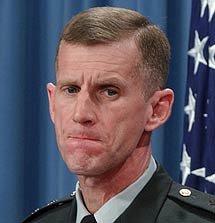
McChrystal´s Decent Interval
The
However, the Taliban were never defeated and threaten to retake the country after Nato
Delivered at the end of August to US President Barak Hussein Obama, he urgently requested 40,000 more combat troops, a political migraine for his commander-in-chief. So far, the president has punted on any decision.
General McChrystal offers at best his commander-in-chief a decent interval, maybe one to two years of breathing space, in the opinion of GSM, before a precipitous retreat in face of an interminable and insurmountable insurgency. The Western democracies will be overcome by exhaustion in terms of blood and treasure in the end.
In three phases, he hopes to reverse Taliban gains and seize the initiative to improve the security situation or ´´defeating the insurgency is no longer possible.´´Higher casualties (and attendant political costs back home) are expected initially to save the war effort while a second component consists of winning the hearts and minds of the Afghan people.
The ´`Afghanization´´ calls for Nato troops to concentrate on the defending population centers and less reliance on air support for combat missions to reduce deaths of innocent civilians. The general forgoes a major Nato advantage and needlessly jeopardizes the foot soldier who will feel the brunt of hand-to-hand combat without air support.
The McChrystal plan is not a strategy at all. It countermands President Obama´s proudly and publicly pronounced policy goals on March 27, 2009 ´´to disrupt, dismantle and defeat al Qaeda in Pakistan and Afghanistan, and to prevent their return to either country in the future.´´ The announcement came before General McChrystal was appointed and an in-theater assessment could be made. Thus, the president acted naively.
The McChrystal plan only buys time which is usually on the side of the insurgent facing a foreign army in his homeland just like before in
Wednesday, September 30, 2009
US in precarious global security jam - Pt I
US President Barak Hussein Obama promised a new America; he has delievered.
The new president of the United States is not a tireless advocate for freedom lovers abroad and the security of his country at home.
He allowed himself to be photographed with Venezuelan President Hugo Chavez who actively plots to diminish US influence in Latin America and undermine Colombia´s democracy. At the same hemispheric conference in April, the US president endured a tirade by Nicaraguan President Daniel Ortega enumerating the supposed crimes Washington had perpetrated in the sweep of Latin American history.
His attorney general, Eric Holder, has unleashed a vindictive investigation of CIA interrogators who produced actionable intelligence to smash terrorist attacks inside the US during the previous presidential administration. Saving American lives and thwarting terror attacks used to be a priority for a US president.
No more. The interrogators will now be interrogated with a noticeable chilling effect on the practice and comforting those subject to it. It is curious to note that Mr. Holder´s old law firm represents and provides legal defense counsel for Yemeni terror detainees at Gitmo.
The US Democrat Party traditionally has opposed any missile defense shield whether for the homeland or not. US President Obama´s decision to abandon the Bush-era missile defense shield housed in the Czech Republic and Poland to protect Europe from Iran´s increasingly iniquitous missile threat fits the pattern.
However, the immediate satisfaction to appease Russia in an empty chance to get help with UN sanctions on Iran rewards Moscow on two fronts. The US slap of two Nato allies genuflects before Moscow´s tough demands on a youthful US president. Additionally, Moscow basks in seeing its ex-Soviet states knocked back a peg or two by the very country that gave much to liberate them from tyranny. The new democratic states in Central Europe will not easily forgive or forget Washington´s betrayal.
US President Obama too easily cossets his enemies and dismisses his friends. US presidents are normally more informed and more careful.
President Obama´s moves to this point weaken the US in an increasinly less secure world. While dumping on allies is easy, the big test, as GSM has reminded its readers, is the challenge posed by Iran. We invite you to read on in part two.