Global Security Headlines

Showing posts with label Islamic fascism. Show all posts

Tuesday, February 22, 2011

#Iran's Med Cruise through #Suez

The on-again off-again news reports about two Iranian warships set to pass through the Suez Canal for the first time since the Revolution is a curious item.

Press accounts have been both frenetic and erroneous. Why?

Chilling Egypt-Israel Relations
Terror, Inc. decided to run the gauntlet now to exploit the chaos in the wake of Mubarak's fall from power.

The Egyptian military junta has apparently decided to allow passage of the British-built Alvand frigate and a supply ship in a purported ''training mission'' in Syria. Sure.

One can speculate about the ''supplies'' Iran brings to Syria and its puppets Lebanon, Hizbullah and Hamas.

It will mark the first time an Iranian warship ever docked at a Syrian port.

The indecisiveness of Cairo to allow the passage shows the chaos in the decision-making process in the power vacuum following the exit of Hosni Mubarak.

It would be nice to know also to what degree the junta's relationship with Israel factored into the agreement. That the ships were granted passage could show a definite chill in Egyptian-Israeli relations.

Conclusions
Flexing naval power is an age-old tactic by states to prove their bona fides as a power player.

None of Iran's moves is calming or for fostering stability.

Terror,Inc's designs to become a regional hegemon are explicit. The quest for nuclear primacy already is an unsettling issue rattling an already shaky region.

Moreover, widening Iranian and Syrian cooperation is another facet of the Iranian cruise into the Med via the Suez. Both terrorist states are aligned for the destruction of Israel.

No doubt Damascus is still fuming about the preventative strike by Israel which destroyed its budding nuclear plant in 2007.

Events in the Middle East are shifting daily, but one observation stands pat - a regional showdown is brewing among the states aimed at the Jewish state.

Whether Sunni or Shia, the Islamist fascist factions agree Israel must be vanquished and plot to realize this perverse dream.

***If you need research from open sources in Spanish, French, or Portuguese and presented in a stylish English language report or a translation of documents in said languages to English, please contact Professor Winn at by sending an email to mrenglish101@gmail.com for a prompt evaluation.

Monday, September 27, 2010

Frightened France Folds for AQIM

French headlines today tell it all:
La gare Saint-Lazare évacuée après une fausse alerte
(St. Lazare Station Evacuated after False Alarm)
Otages du Sahel: Paris attend les exigences d'Aqmi
(Sahel Hostages: Paris Awaits AQIM's Demands)
L’Élysée prêt à negocier
(French Government Ready to Negotiate)

rfi.fr
France rightly fears an AQIM (Al Qaeda in Islamic Maghreb) attack after a French hostage was murdered in the Sahel last July following a daring yet unsuccessful French raid, the Eiffel Tower was closed after a (false) bomb threat two weeks ago, and another group of French workers was kidnapped just last week in Niger. 

AQIM is an expansion of the Al Qaeda franchise which developed out of an Algerian terrorist group. It has found a fertile recruiting ground in the lawless and economically-depressed Sahel (meaning ''edge'' or ''shore'' of desert).

AQIM is also involved in transnational narcotics trade to fund its operations.

Official denials to the contrary, if France again pays tribute to terrorists for seizing its nationals, expect more of the same. 

Unfortunately, the Sarkozy Administration is in the political doldrums and certainly does not need a hostage drama to remind les français of its perceived ineffectiveness.

A constant terror threat only complicates his portfolio of foreign policy challenges. 

Defeating terrorism is a test of wills. A rogue group in the African desert cannot be allowed to force France to fold before Islamic fascism. 

Conquering fear calls for facing it. 

***
If you need research from open sources in Spanish, French, or Portuguese and presented in a stylish English language report or a translation of documents in said languages to English, please contact Professor Winn at by sending an email to mrenglish101@gmail.com for a prompt evaluation.

Monday, August 9, 2010

Brazil - Iran Split on Stoning Punishment

Add Brazil to the list of countries willingly hoodwinked by Terror,Inc.

In May, Brazil linked up with Turkey to provide a fig leaf for the Teheran Tyranny to escape "harsh" UN sanctions by getting Iran to sign an accord to "swap lightly enriched uranium for more highly enriched supplies."

Brazilian President Lula´s big diplomatic play on the world stage flopped. He wasted his reserve of political capital to help out his friend Hugo Chavez of Venezeula, a close ally of  theTeheran Tyranny.

Fast foward to August. A young Iranian woman, Sakineh Mohammadi Ashtianthe, faces the antidiluvian punishment of stoning to death for alleged adultery.

Lula hoped to once again use his good offices and his "relação de amizade" (friendly relationship) to prevail upon his counterparat, the public face of the Teheran Tyranny, Mahmoud Ahmadinejad, by offering political asylum to spare her life.

Terror,Inc. no doubt thanks Lula for the fig leaf on the nuclear front, but soundly rejected him. The Brazilian president was "misinformed" about the case, a spokesperson said.

No one is misinformed about a rogue regime that continues to defy the international community with impunity. Its barbaric and macabre tactics terrorize not only the Iranian people, but others in the world through its Islamic fascist terrorism.

Brazil, an emerging giant on the world stage, should choose its friends more carefully.

Alignment with Terror,Inc. has not redounded positively for Brasilia as evidence by the split now evident in the "friendly relationship."

***
If you need research from open sources in Spanish, French, or Portuguese and presented in a stylish English language report or a translation of documents in said languages to English, please contact Professor Winn at by sending an email to mrenglish101@gmail.com for a prompt evaluation.

Sunday, July 25, 2010

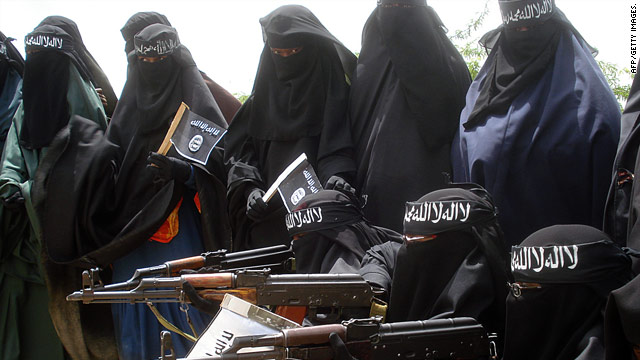
Al Shabaab - cnn.com
Al Qaeda remains a significant and growing threat to global security.

Somali-based Al Shabaab's attack in Kampala, Uganda, following the World Cup final earlier this month is credited by terrorist experts as a play for official membership in the Al Qaeda franchise club.

Uganda was not a random target. Its peacekeepers protect the weak Somali government which Al Shabaab hopes to sack. 

AQIM (Al Qaeda in the Islamic Maghreb-Sahel) operates in Sub-Saharan Africa and poses a direct danger to western Europe. It likes to capture and kill relief workers trying to improve the lives of those trapped in the desolate region.

In Yemen, the UK ambassador and his convoy narrowly survived a suicide bomb attack last April credited to  Al Qaeda in the Arabian Peninsula (AQAP).

AQAP is expanding its reach and scale of operations. In fact it just released its first English-language Inspire magazine for entrepreneurial suicide bombers in order to connect with a worldwide recruitment pool.

Moreover, AQAP is directly tied to the so-called Christmas Day bomber in the United States last year.

While the main Al Qaeda organization is pressured in Iraq, Afghanistan, and Pakistan, start ups and franchises proliferate where lawlessness prevails like in the Sahel, Somalia, and Yemen.

It is clear the West's efforts to control the tide of terror wrought by Islamic fascism is failing.

While the real war is inside Islam, the West is a convenient target both in the minds and in the deeds of militant Islamics as an expression of their fundamentalist rage against the modern world.

***
If you need research from open sources in Spanish, French, or Portuguese and presented in a stylish English language report or a translation of documents in said languages to English, please contact Professor Winn at by sending an email to mrenglish101@gmail.com for a prompt evaluation.

Friday, July 23, 2010

Daring French Raid in Northern Mali

Northern Mali is the suspected headquarters for Al Qaeda in the Islamic Mahgreb (AQIM).

On Thursday, France presumably tried to rescue hostage Michel Germaneau in the region after a death threat by his captors, according to press reports. Its success is unknown.

A host of west European countries including Spain, France, Austria, and even Switzerland have had hostages taken in the Sahel by AQIM. Its tentacles reach deep into these countries.

Spain is actually more in the sights of AQIM than France, according to J. Peter Pham in World Defense Review.

Jihadist expert María Amparo Tortosa Garrigós explains in Madrid's El País in an interview last December that AQIM is creating an ''Afghanistan in the Sahel,'' a dagger aimed right at the EU.

***
If you need research from open sources in Spanish, French, or Portuguese and presented in a stylish English language report or a translation of documents in said languages to English, please contact Professor Winn at by sending an email to mrenglish101@gmail.com for a prompt evaluation.

Thursday, December 31, 2009

Top 6 Strategic Questions for 2010

Ancient Greek Plato´s teacher, Socrates, created a discipline based on asking the right questions.

For 2010, I pose the following 6 strategic questions concerning global security.

6 Strategic Questions for 2010

1. What will the international community do about Iran?
Iran´s rogue regime is nearing nuclear breakout (see Net Assessment:Iran) and tests ballistic missiles to deliver them at increasing greater ranges. The widespread public unrest over the burial of opposition leader, theGrand Ayatollah Hossein Ali Montazeri, coincided with the Shia holiday of Ashoura and clashes with government security forces resulted in  many arrests and deaths. Notable is the student unrest, the country´s future. Just like the reaction in October to Mr. Ahmadinejad's fraud-tainted re-election as president, clearly the Iranian street is bubbling over with rage at the regime. The tyrants in Teheran represent a clear and present danger to Iran and the world.

2. Will radical Islamic terrorism wax or wane?
Is the so-called "Christmas Bomber" of Northwest Flight 253 to Detroit an opening shot in a wave of radical Islamic terrorism against Western interests around the world? Ungovernable Somalia and war-torn Yemen make the Horn of Africa region a hot zone haven for terrorists. Al Qaeda Arabian Peninsula (AQAP) and Al Qaeda Islamic Maghreb (AQIM) are active as well. The tyrants in Teheran also figure into the equation given the current regime is Terror, Inc. Radical Islamic terrorism is mostly organized by state sponsors and serves as a proxy to attack larger and more powerful states.

3.  What will China’s recent gains in diplomatic currency portend?
China has risen. The Middle Kingdom´s audacious diplomatic play at the so-called climate change conference in Copenhagen in early December by besting the overmatched US President Obama is more evidence (see "China Can Say No"). China surpassed Germany at the beginning of 2009 to become the third-largest economy in the world and will pass Japan to become the second in 2010. Beijing is claiming the diplomatic power equal to its economic power. Attendant military power and more muscular power projection continues. One weakness is its so-called "soft power" or cultural assertiveness. China offers an alternative to US preeminence and it does not shy away from it.

4.  Will the Nato mission fail in Afghanistan?
Nato is losing in Afghanistan. US President Obama's half-measure of 30,000 more combat troops plus another 5,000 (pledged) from Nato allies is unlikely to turn the tide. Together, the troop contingent is the bare minimum General McChrystal requested for his new strategy. An added worry: Pakistan may yet yield to Taliban and Al Qaeda pressures complicating any scenario for "victory."

5.   Does Castro, Inc. survive?
¿Fin de la Revolución?  Castro, Inc. celebrated the 40th anniversary of its violent overthrow of strongman Batista on January 1 this year. La revolución exchanged one corrupt blood-thirsty strongman for another corrupt blood-thirsty strongman, Fidel Castro. Forty years and absolute power allowed the Castro brothers to amass a vast wealth to the point billionaire Fidel ranked in Forbes list in 2006. This came despite the hated US embargo, el bloqueo (blockade) in Castro Spanish. After a fair wage for the boss, El Jefe, really, how much is left for the proletariat?

Hard times again have hit the regime. The Castro business survived the high drama of the October 1962 missile crisis sparked by Soviet missiles on the island in Mr. Castro´s hot-headed attempt to use Moscow to get revenge on Washington after Bay of Pigs. It muddled through the  período especial (special period) after the collapse of the Soviet Union and the sugar subsidy scheme evaporated.  Castro investments in tourism and sexual exploitation were attempts to earn more hard currency, as if drug smuggling is not enough.Then, El Jefe himself, reaching mortality, "temporarily" passed the baton to brother Raúl. The king stepped aside.

Will the deteriorating status quo hold? Whenever Fidel Castro dies, the pernicious disease of Castroism has been spread to others in the region, but at least the prisoners on the paradisaical island would win the freedom and full meal they deserve if the military moved to save la patría (country).

6. What is next for the European Union?
The EU-27, from the humble beginnings of the European Economic Community (EEC), now ranges from the Atlantic Ocean to the border with Russia. Spain, the "new sick man of Europe," becomes the president for the next six months on January 1. Presidente Zapatero states he hopes to superar la indiferencia de la ciudadanía respecto a Europa (overcome the indifference to Europe). The disconnect between European elites and the citizenry has plagued the EU from the start.

It is the economy, stupid. In the Eurobarometer 72 released this month, 54% of the EU-27 believe the "worse it yet to come" economically. Socialism does not work. That failed economic theory gnaws at the core of the EU´s troubles. Double digit unemployment afflicts the member states. The EU eked out 0.4% growth in the third quarter officially ending the recession on paper. At the close of 2009, Greece emerged as a threat to the euro. There still is no president of Europe. A shared history and the attendant lingering mutual suspicions, an aging population in rigid welfare states, weak military strength and hesitancy to fully support the Nato mission in Afghanistan, energy dependence on Russia and Iran, and a Tower of Babel in diplomacy, all detract from the "union" which appears more like a collection. Add fierce nationalism in the latest round of EU appointments and large nations pitted against smaller nations as even more evidence of disunion.

Happy 2010!
***
If you need research from open sources in Spanish, French, or Portuguese and presented in a stylish English language report or a translation of documents in said languages to English, please contact Professor Winn at by sending an email to mrenglish101@gmail.com for a prompt evaluation.

Thursday, December 3, 2009

Mr. Obama´s Top 6 Foreign Policy Flops

Top 6 Obama Foreign Policy Flops

6. Honduras - Washington initially backed the constitutionally-removed Mel Zelaya who sought to perpetuate his presidential term beyond its time limit. It was disgraceful to embrace false coup language and side with the Castro-Chavez Club in Latin America.

5. China - President Obama was roundly criticized for showing weakness and undue deference to Beijing, the United States´ major creditor. He tepidly spoke about human rights and returned home empty-handed on issues ranging from the environment and help with Iran.

4. Afghanistan - In his latest speech, Mr. Obama abandons the war effort to defeat Al Quayda and the Taliban and signals a fundamental absence of understanding about international affairs and how to confront tyranny.

3. Russia - The US president abandoned Central European allies the Czech Republic and Poland by withdrawing a Bush-era missile defense shield against Iranian (and Russian) missiles, all in a vain effort to curry favor with Moscow on Iran sanctions.


2. Iran - It is clear that Washington has no desire to stop the Teheran Tyrants from acquiring nuclear weapons and the missiles to deliver them. Words alone cannot and do not tame tyrants. Human history is replete with examples. Sadly, the US president is not a student of history. GSM will release an exclusive Net Assessment with more details about the Iranian impasse.


1. War on Islamic Fascism - The United States is at war despite inexplicable behavior by the country´s president to deny that reality and act in a cavalier manner toward the most serious threat to the nation´s survival. From allowing some key parts of the Patriot Act to expire, closing the facilities at Guantonomo Bay to interrogate prisoners for intelligence to prevent future attacks, to allowing a civilian court trial for Khalid Sheik Muhammaed and other alleged perpetrators of the 9/11 attacks and to flinching in the stares of evil from Iran and the Al Quayda/Taliban threat in Afghanistan, it is obvious Mr. Obama is severely misinformed about the true nature of the threat.

The war within Islam has become the world´s problem manifested in the various terror groups from Asia to America. By not taking on Terror Inc - Iran - directly, the United States is treading dangerously in an increasingly unstable world partly because of US tepidness and disengagement.

Tuesday, November 10, 2009

Cold War Series Part IV: Lessons Learned


“We win, they lose.” - Ronald Reagan´s strategy for the Cold War


GSM concludes its four part series on the Cold War examining the lessons learned recalling the maxim studying history is to (hopefully) avoid repeating it.

First, a just cause and the will to advance it are key ingredients in a struggle. The Western powers and their allies around the world united their efforts to oppose Soviet-inspired tyranny  Every continent was affected by the East-West contest. Though progress waxed and waned, the thirst for freedom by the oppressed cowering at the boot of the dictator sustained the West´s effort to defeat Soviet communism.


Second, the spiritual aspect of the democracies, especially the appeal in East Europe by the Pope John Paul II in the Vatican, is credited with fueling the Solidarity trade union resistance in his native Poland. Moscow attempted to assassinate the Pope and never underestimated his ability to expose the hollowness of secular communism. The ´´holy alliance´´ between former US President Reagan and former Pope John Paul II proved a potent antidote to the raw atheistic offerings of Soviet communism. Faith to overcome the heavy boot of tyranny sustained many behind the Iron Curtain. In addition, the moral element embodied in Reagan´s ´´evil empire´´ comment drew the battle lines tight with the practitioners of tyranny like Solzhenitsyn´s Gulag Archipelago.

Third, military superiority spearheaded by President Reagan´s military buildup and modernization of strategic weaponry narrowed the gap with the Soviet Union. The military maliase following the Vietnam War defeat, highlighted by the ´disaster in the desert´ to rescue the Iranian-held hostates in 1980, left the United States vulnerable in the air, land, and sea. The buildup demonstrated US resolve at a critical time. The Warsaw Pact held the number superiority, but the West compensated with superior technology.

Fourth, in deed, the technological edge, particularly the mere threat of a Strategic Defense Initiative (derided by the Western press as ´´Star Wars´´) convinced the Soviets to seriously reconsider both the nature of the struggle with the West and the confident Reagan leadership in the White House. The KGB thought the tech gap with the West undermined Moscow´s ability to compete. Reagan doubled down on the costs for the Soviets to compete with the West, essentially to bankrupt Moscow.

Fifth, the ideological economical competition pitted free markets versus Marxism and capitalism won. The Soviet 5-Year plans as required by the command economy were folly. The more productive West despite intermittent cyclical market downturns proved the superior economic system to provide the most basic goods and social mobility for a better life.

Finally, the will to win and overcome cannot be underscored enough. The democracies´ will to win was flagging when former US President Reagan and former British Prime Minister Margaret Thatcher appeared on the scene at a crucial time in world history to dispatch Soviet communism to the ash heap of history. One wins by imposing your will on the opponent. Mr. Reagan and Mrs. Thatcher imposed the West´s will on Mr. Gorbachev who only sought to reform communism instead of killing it. Laurels for Mr. Gorbachev are misguided. His card hand was not very appetizing when he appeared on the scene to preside over the dissolution of the East European dictatorships, a Soviet leader´s nightmare.

The West won and the Soviet Union lost just as Reagan quipped in our quote above. The end of the Cold War was not marked by victory parades or grand displays in contrast to the May Day celebrations in Moscow every year. Regrettably, many in the democracies are unaware of the high stakes involved in the titanic struggle with Moscow and worse, many sympathized if not openly sided with Moscow.

We live in a more dangerous multipolar world today without any longing for the managed bipolar world of the Cold War. Nuclear technology and ballistic missiles are more available around the world in the hands of tyrants. There is no Reagan or Thatcher on the scene in the democracies to confront the scourage of Islamic fascist terrorism, nuclear-tipped tyrants or other asymetrical challenges to freedom and pluralism.

Leaders in the democracies today do good to heed these lessons and apply them forthright or risk horrifying consequences.


Get your International Policy books today!

Wednesday, October 28, 2009

GSM Daily: Afghan-Pakistan Contagion

The fates of Afghanistan and Pakistan are intertwined.

Dual attacks in the Afghan capital of Kabul and Peshwar in Pakistan today underscore the dire security threat each country faces. The inability of each country´s weak central government to exercise state control over all its territory, widespread corruption, and Al Quayda and Taliban elements on their murky border beset both.

The fragility of each country´s existence as states is an interminable vexing issue for global security analysts to predict likely outcomes of the Afghan-Pakistan contagion.

If the Taliban returns to Kabul and an Islamic fascist faction upends the current government in Islamabad (and gains control of the nuclear weapons), the security dynamics in the region change suddenly and for the worse.

from France2:

Kaboul: 6 employés de l'Onu tués par les talibans

Kabul: 6 UN employees killed by the Taliban

La sécurité a été renforcée mercredi matin à Kaboul pour protéger les étrangers après des attaques de talibans

Security reinforced Wednesday morning in Kabul to protect foreigners after Taliban attacks

A l'aube, six employés de l'ONU ont péri dans l'attaque de leur maison d'hôtes. Puis deux roquettes ont été tirées sur un hôtel de luxe Serena, à Kaboul, sans faire de victimes.

Six UN employees died in a dawn attack on their housing complex. Two rockets slammed into the the luxurious Serena hotel aftewards in Kabul without any injuries.

Les talibans ont revendiqué ce qu'ils appellent la "première étape" de leur campagne visant à déstabiliser le 2e tour de l'élection présidentielle, prévu le 7 novembre.

The Taliban said it is the ´´first stage´´ of their campaign to disrupt the second round of the presidential election scheduled for November 7.

Tuesday, October 27, 2009

McChrystal´s Decent Interval

White Paper of the Interagency Policy Group's Report on

The United States and its Nato allies are losing the war in rugged Afghanistan against a more rugged foe – the Taliban, the Islamic fascists and former leaders ousted after the US invasion in October 2001 following the 9/11 attacks.


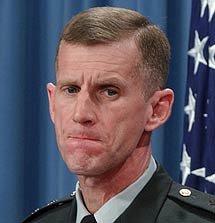
However, the Taliban were never defeated and threaten to retake the country after NatoWhite Paper of the Interagency Policy Group's Report on´s disastrously disjointed and disunited eight-year fight, according to General Stanley A. McChrystal´s bleak assessment.


Delivered at the end of August to US President Barak Hussein Obama, he urgently requested 40,000 more combat troops, a political migraine for his commander-in-chief. So far, the president has punted on any decision.


General McChrystal offers at best his commander-in-chief a decent interval, maybe one to two years of breathing space, in the opinion of GSM, before a precipitous retreat in face of an interminable and insurmountable insurgency. The Western democracies will be overcome by exhaustion in terms of blood and treasure in the end.


In three phases, he hopes to reverse Taliban gains and seize the initiative to improve the security situation or ´´defeating the insurgency is no longer possible.´´Higher casualties (and attendant political costs back home) are expected initially to save the war effort while a second component consists of winning the hearts and minds of the Afghan people.


The ´`Afghanization´´ calls for Nato troops to concentrate on the defending population centers and less reliance on air support for combat missions to reduce deaths of innocent civilians. The general forgoes a major Nato advantage and needlessly jeopardizes the foot soldier who will feel the brunt of hand-to-hand combat without air support.


The McChrystal plan is not a strategy at all. It countermands President Obama´s proudly and publicly pronounced policy goals on March 27, 2009 ´´to disrupt, dismantle and defeat al Qaeda in Pakistan and Afghanistan, and to prevent their return to either country in the future.´´ The announcement came before General McChrystal was appointed and an in-theater assessment could be made. Thus, the president acted naively.


The McChrystal plan only buys time which is usually on the side of the insurgent facing a foreign army in his homeland just like before in Vietnam and like now in Afghanistan.