Global Security Headlines

Wednesday, November 11, 2009

Headless in Berlin


Freedom is indivisible, and when one man is enslaved, all are not free.
-  Former US President John F. Kennedy in his Berlin speech, June 1963

The United States was left headless in Berlin last Monday.
 
US President Barak Hussein Obama did not deign to visit the 20th anniversary of the Berlin Wall´s fall for three main reasons. Instead, he dispatched Secretary of State Hillary R. Clinton, a diplomatic downgrade, to mingle with the presidents and prime ministers of US allies in Europe.

It is a despicable act and a shameful behavior by the leader of the free world and president of the very country that forced the hands of the communist dictatorships to surrender leading to fall of the Iron Curtain symbolized by the fall of the odious Berlin Wall twenty years ago. Unfortunately, it is consistent with a US president ill at ease with American success and leadership in the world and devoid of intellectul curiosity about global security.

Tone death to history, US President Barak Hussein Obama betrayed the legacy of his Democrat Party´s main icon in the latter half of the last century,  John F. Kennedy, who proudly stood at the wall and declared: ´´All free men, wherever they may live, are citizens of Berlin, and, therefore, as a free man, I take pride in the words "Ich bin ein Berliner.´´

US President Obama, who is often lauded for his soaring rhetoric, cannot ever match the substance of former President Kennedy nor his committment for freedom, sadly.

Moreover, the Democrat Party was on the wrong side of history seeking more accomodation and less confrontation with the Soviet Union after the US reversal in the Vietnam War. Perhaps President Obama did not want to bring attention to this fact.
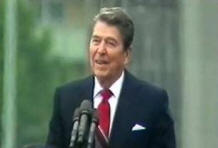

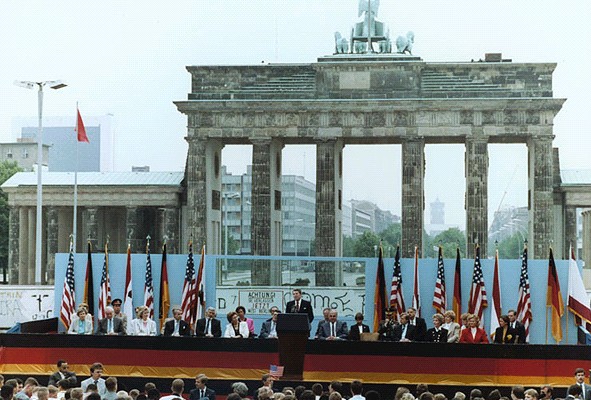
However, the fall of the Berlin Wall is not viewed by many Americans as a partisan achievement while it is undeniable the impetus for forcing the communist dictatorships in Eastern Europe to yield to the thirst for freedom by their people was Ronald Wilson Reagan, a member of the Republican Party, the Democrat´s main political opponent. In June of 1987, former US President Ronald Reagan proclaimed at the Wall:

´´I noticed words crudely spray-painted upon the wall, perhaps by a young Berliner (quote):"This wall will fall. Beliefs become reality." Yes, across Europe, this wall will fall, for it cannot withstand faith; it cannot withstand truth. The wall cannot withstand freedom.´´

Indeed, a little freedom is very dangerous for tyrannical regimes. Liberty cannot be snuffed out by concrete and steel when the will of the people is greater than its dictators.

President Obama´s absence at the anniversary last Monday is a telling indictment on his rank inability to fulfill the august duties of president and serve as the number one advocate defender of freedom, a horrifying combination. Today´s tyrannts may misread the US president´s snub and imperil global security further.

Tuesday, November 10, 2009

Cold War Series Part IV: Lessons Learned


“We win, they lose.” - Ronald Reagan´s strategy for the Cold War


GSM concludes its four part series on the Cold War examining the lessons learned recalling the maxim studying history is to (hopefully) avoid repeating it.

First, a just cause and the will to advance it are key ingredients in a struggle. The Western powers and their allies around the world united their efforts to oppose Soviet-inspired tyranny  Every continent was affected by the East-West contest. Though progress waxed and waned, the thirst for freedom by the oppressed cowering at the boot of the dictator sustained the West´s effort to defeat Soviet communism.


Second, the spiritual aspect of the democracies, especially the appeal in East Europe by the Pope John Paul II in the Vatican, is credited with fueling the Solidarity trade union resistance in his native Poland. Moscow attempted to assassinate the Pope and never underestimated his ability to expose the hollowness of secular communism. The ´´holy alliance´´ between former US President Reagan and former Pope John Paul II proved a potent antidote to the raw atheistic offerings of Soviet communism. Faith to overcome the heavy boot of tyranny sustained many behind the Iron Curtain. In addition, the moral element embodied in Reagan´s ´´evil empire´´ comment drew the battle lines tight with the practitioners of tyranny like Solzhenitsyn´s Gulag Archipelago.

Third, military superiority spearheaded by President Reagan´s military buildup and modernization of strategic weaponry narrowed the gap with the Soviet Union. The military maliase following the Vietnam War defeat, highlighted by the ´disaster in the desert´ to rescue the Iranian-held hostates in 1980, left the United States vulnerable in the air, land, and sea. The buildup demonstrated US resolve at a critical time. The Warsaw Pact held the number superiority, but the West compensated with superior technology.

Fourth, in deed, the technological edge, particularly the mere threat of a Strategic Defense Initiative (derided by the Western press as ´´Star Wars´´) convinced the Soviets to seriously reconsider both the nature of the struggle with the West and the confident Reagan leadership in the White House. The KGB thought the tech gap with the West undermined Moscow´s ability to compete. Reagan doubled down on the costs for the Soviets to compete with the West, essentially to bankrupt Moscow.

Fifth, the ideological economical competition pitted free markets versus Marxism and capitalism won. The Soviet 5-Year plans as required by the command economy were folly. The more productive West despite intermittent cyclical market downturns proved the superior economic system to provide the most basic goods and social mobility for a better life.

Finally, the will to win and overcome cannot be underscored enough. The democracies´ will to win was flagging when former US President Reagan and former British Prime Minister Margaret Thatcher appeared on the scene at a crucial time in world history to dispatch Soviet communism to the ash heap of history. One wins by imposing your will on the opponent. Mr. Reagan and Mrs. Thatcher imposed the West´s will on Mr. Gorbachev who only sought to reform communism instead of killing it. Laurels for Mr. Gorbachev are misguided. His card hand was not very appetizing when he appeared on the scene to preside over the dissolution of the East European dictatorships, a Soviet leader´s nightmare.

The West won and the Soviet Union lost just as Reagan quipped in our quote above. The end of the Cold War was not marked by victory parades or grand displays in contrast to the May Day celebrations in Moscow every year. Regrettably, many in the democracies are unaware of the high stakes involved in the titanic struggle with Moscow and worse, many sympathized if not openly sided with Moscow.

We live in a more dangerous multipolar world today without any longing for the managed bipolar world of the Cold War. Nuclear technology and ballistic missiles are more available around the world in the hands of tyrants. There is no Reagan or Thatcher on the scene in the democracies to confront the scourage of Islamic fascist terrorism, nuclear-tipped tyrants or other asymetrical challenges to freedom and pluralism.

Leaders in the democracies today do good to heed these lessons and apply them forthright or risk horrifying consequences.


Get your International Policy books today!

Monday, November 9, 2009

Honduran Crisis: Recognize Michelleti Now


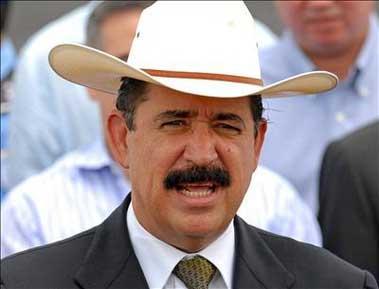
Honduras is no better off after constitutionally-ousted former president of Honduras, Manuel Zelaya, cries foul over a breakdown of the accord leading to his restitution and a national unity government: ´´The accord is dead.´´ 


The accord forced upon the interim President Michelleti by the disgraced OAS calls for a vote by the Honduran Congress and Supreme Court before Zelaya supposedly returns to power. However, the Honduran Congress and Supreme Court voted him out of power, thus sparking the ´´crisis.´´ Just because one is president he or she is not above the law as Mr. Zelaya found out.

There is no evidence Mr. Zelaya has learned a lesson from his constitutional ouster. There is no contrition. Authoritarians rarely say ´´I am sorry.´´ His designs for Honduras to continue as a transhipment point for Venezuelan drug planes and to become a junior member of the Castro-Chavez Club are unaltered.

Thus, Mr. Zelaya is a threat to Honduran democracy. His street thugs agitating for his return at any costs, including attacking the attorney general investigating his alledged long list of crimes last weekend, are very similar to the same outlaws enforcing Chavezism in Venezuela.

Brazil still provides diplomatic cover for Mr. Zelaya housing him in their embassy. The United States first rushed to support him because of ´´coup´´ talk (false).

It is time for regional powers and the international community as a whole to recognize the Micheletti government in Tegucigalpa and recognize Mr. Zelaya was dutifully dismissed and let Honduras resolve its problems alone.

Freedom and democracy are in the balance.

Get your International Policy books today!

Cold War Series - Part III: How the Cold War Was Won


´´General Secretary Gorbachev, if you seek peace, if you seek prosperity for the Soviet Union and Eastern Europe, if you seek liberalization: Come here to this gate! Mr. Gorbachev, open this gate! Mr. Gorbachev, tear down this wall!´´
-
Former US President Ronald W. Reagan, June 12, 1987.

In the end, the Cold War was won by defeating the Soviet Union, a novel concept.

In arguably the West´s darkest moment, Ronald Wilson Reagan, a former actor and governor of California, and Margaret Thatcher, the daughter of a humble grocery store owner, were elected president of the United States (1980) and prime minister of the United Kingdom (1979) respectively. This dynamic duo would steer the West to victory against tyranny.

In 1980, the United States was reeling from twin humiliating reversals: the ghosts of Vietnam and the 444-day hostage drama at the hands of Islamic Republic of Iran, both inflation and unemployment were in double digits and above all US morale was flagging. The Soviets had invaded Afghanistan and the strategic balance in Europe favored Moscow with its deployment of mobile SS-20 missiles. The challenge was cast. Washington and London readily accepted.


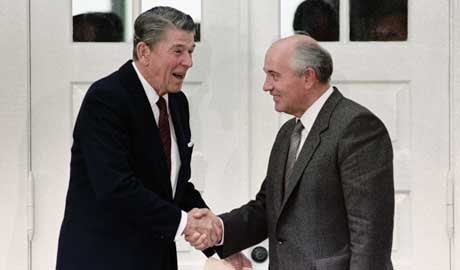
US President Reagan defied the ruckus of KGB-funded peace movement in West Europe and deployed Pershing II and cruise missiles throughout Nato countries to counter the Soviet threat. He finally had a summit with Mikhail Gorbachev in Reykjavik, Iceland, after a series of Soviet leaders died in office over what became the INF (Intermediate Nuclear Forces) Treaty to scrap these missiles.

In a departure from past negotiations, Reagan negotiated from strength: the largest military buildup since Vietnam and an ace in the hole - the Strategic Defense Initiative (SDI) derided by the naive Western news media as ´´Star Wars´´ to discount its realistic function and purpose - creating a missile shield to protect the West from Soviet missiles. His vision then is still inspiring today.

Mr. Gorbachev knew the danger SDI posed to Moscow. The technological gap persisted throughout the Cold War after the Soviets launched Sputnik first in expanding competition into space. The introduction of anti-aircraft missiles in Afghanistan and the rugged mujahideen created the ´´Soviet Vietnam.´´ His perestroika (restructuring) and glasnost (opening) policies lulled the naive Western media, but they were futile attempts to reform and save communism from the dustbin of history. His hand was forced by SDI and the iron will of mainly Reagan and Thatcher backed by credible military force to end the communist menace. Any credit to Mr. Gorbachev is in recognizing the defeat of the Soviet Union.

In the end, visionary leaders, iron nerve backed by strength, and technology gave a strong push to cause the ailing Soviet Union to fail and condemn its brand of communism to the deathbed.


Get your International Policy books today!