Global Security Headlines

Sunday, November 8, 2009

Cold War Series Part II: How the Cold War Was Not Won


 In our second series on the Cold War to commemorate the 20th anniversary of the fall of the odious Berlin Wall
on November 9, we examine how the West did not win the Cold War.

Our first part covered the Soviet communist ascendancy. Our final part of the series addresses lessons learned and informed perspectives about the ideological struggle between the United States and its allies against the Soviet Union and its client-states.

First, it is helpful to learn how the Cold War was not won. The ´´long telegram´´ from Moscow, written by ´´Mr. X´´ later appearing in Foreign Affairs in July 1947 (´´The Sources of Soviet Conduct´´), kicked off the intellectual debate about how to confront Soviet communism. Then US diplomat George F. Kennan in the US Embassy in Moscow argued for containment of Soviet expansionism. His identity remained secret for years, but his thoughts shaped the initial US response to the Soviet challenge. However influential and insightful, containment was a mere holding strategy - accepting Soviet communism and a losing strategy to keep it from flowing to other parts of the world.

Second, the Cold War was not won through détente - (relaxation in French) - a relaxing of tensions between the United States and Soviet Union, usually at moments of Soviet exhaustion to buy time. US-Soviet summits were mainly media events, carefully managed, and coveted by the often naive Western media who pressured the US side for concessions. The main topic was nuclear arms talks resulting in estimable treaties between the two sides. Agreements and treaties are only valuable if both sides intend to adhere to them. A piece of paper with signatures does not tame a sworn enemy.

 Containing tyranny and talking with tyrants do not solve the problem - how to protect freedom in the Hobbesian international system governed by the aggressive use of force. In part three of our series, we report how the West won the Cold War without the often-feared horrific nuclear exchange between Moscow and Washington. 


Get your International Policy books today!

Saturday, November 7, 2009

Cold War Series Part I: Soviet Communist Ascendancy


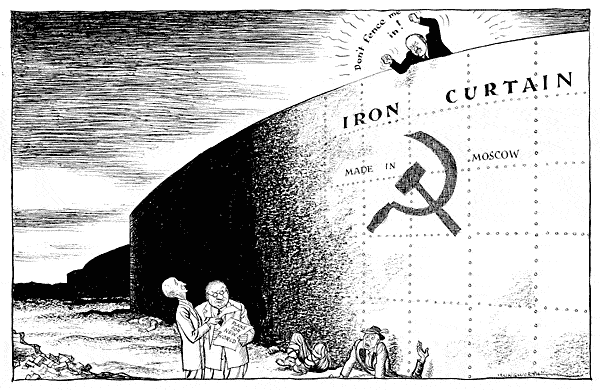
November 9, 2009, marks the 20th anniversary of the fall of the odious Berlin Wall, a symbolic event for ushering in the end of the Cold War. An ´´Iron Curtain,´´ separating East and West Europe, walls, vicious guard dogs, prison camps, barbed wire, minefields, no-mans land, Checkpoint Charlie, and soldiers at the ready were implements of tyrannical regimes to enslave their people, dash their dreams, and maintain total control through the gun barrel.

The Western democracies led by the United States rejected this barbarism.

GSM in a four part series reviews the Cold War. Part I covers the ascendancy of Soviet communism. Part II shows how the Cold War was not won. Part III demonstrates how the West´s iron-willed determination forced Moscow to relent. Finally, Part IV expounds upon the lessons learned which are applicable to the current international system.

 From the ashes of World War II sprang almost immediately the Cold War, the titanic struggle between the West (NATO) and the East (Warsaw Pact). Namely, the United States and the Soviet Union managed a rivalry across the global chessboard for supremacy. Would tyranny and command economics triumph over freedom and market economics? For 46 years, the two sides competed for prestige, allies to carry forward the fight, and of course, victory.

The early contests began in the divided Germany - Federal Republic of Germany (West Germany) and the German Democratic Republic (East Germany) in the former Nazi capital - Berlin. The West led by US President Harry Truman defied Soviet attempts to block land routes into western Berlin (where the western Allies had divided the capital into zones) with a massive airlift transferring supplies to 2.2 million inhabitants. The Soviets did not act to stop the airlift and the crisis abated and West Berlin became an island of freedom and market economics in the heart of East Germany. West Berlin and the divided Germany would be a constant thorn in the side of the Soviet Union throughout the Cold War.

The US-Soviet rivalry stretched across the globe touching every continent. US President Truman believed China´s helped spark the Korean Conflict which was fought to a stalemate. That unsettled conflict precipitated a challenge later in Vietnam where first the French were evicted by a nationalistic communist insurgency and later the United States who left the quagmire with a shameful defeat. The dominoes fell later as predicted in Laos and Cambodia who also fell under communist tyranny. Re-education camps and ´´the killing fields´´of Cambodia proceeded to subject millions to a fate of certain death.

Indeed, the 1970s can arguably be the apogee of Soviet communism. The West was reeling. Many observers believed Moscow´s march was unstoppable and that capitalism was a spent force. At the height of the Arab-Israeli War in 1973, US President Nixon put the country on DEFCON3 (Defense Readiness Condition) to deter the Soviets from intervening.

However deadly serious, the second direct confrontation between Moscow and Washington occurred a decade earlier during the  Cuban Missile Crisis of 1962 which nudged the United States and the Soviet Union closer to mutually assured destruction (MAD). The wily Castro in Havana and reckless Khrushchev in Moscow pushed the US Kennedy Administration to the brink over nuclear missiles in Cuba.

These hot points during the Cold War again redounded to a test of wills. Join us for Part II of our series where we explore how the Cold War was not won. Our final post on the series reflects more on the extraordinary time period the Cold War covered in world history and lessons applicable to global security challenges today.

Get your International Policy books today!

Sunday, November 1, 2009

Persian Peril Percolates While West Wanes


"J'espère que ces négociations vont se poursuivre, que les éléments sataniques ne pourront pas les perturber, car le régime sioniste et les puissances dominatrices sont mécontents", a déclaré le président iranien, selon Isna.


´´I hope these negotiations continue [and] that the Satanic forces will not be able to disrupt them because the Zionist regime and domineering powers are dissatisfied.´´

´´Washington is expected to continue to engage Tehran toward a deal on Iran's nuclear program, according to both government sources and American sources accompanying U.S. Secretary of State Hillary Clinton on her lightning visit to Israel Saturday´´ - Haaretz.com, 11/01/2009

´´Iran must demonstrate through concrete steps that it will live up to its responsibilities with regard to its nuclear program.´´ - US President Obama, 10/02/2009 after P-5+1 talks in Geneva.

The Teheran Tyrants know they have won. Iran skipped providing an answer by the October 23 deadline on the ridiculous nuclear enrichment deal. More defiance from the Teheran Tyrants and yet the Obama Administration reportedly (from Haaretz above) is still on the talk-a-thon track. Incredible!

The Western powers at this late date face two unpalatable options: 1) worthless sanctions and 2) a military campaign to cripple Teheran´s nuclear capabilities. The first option is more likely because the United States led by President Obama has no intellectual curiosity about how the world actually works and worse anyone in the his inner circle who does.

A military campaign is fraught with complexity and difficulty given the extensive layout of Iran´s nuclear facilities across the Persian state and the built-in redundancy. It would require a sustained operation to be effective. The repercussions with Russia and China have to be weighed beforehand as well.

When the Bush Administration did not follow up Iraq with confronting Iran more forcefully (as if killing US soldiers in Iraq was not an act of war), the mullahs in Teheran knew the coast was clear. An inexperienced president from a traditionally anti-war (Democrat) party was manna from heaven after the 2008 US elections.

World history is replete with examples when a determined foe is not confronted until the last hour. It is incredible to believe suddenly Iran will scrap its crown jewel overnight to please the Western powers after investing billions of oil dollars in research, materiel, nuclear scientists, and advanced ballistic missiles to deliver their lethal cargo.

Its protectors in the proxy war with the United States, Russia and China namely, provide Teheran the cover required to defy Washington. The smart bet is to believe the naive US president does not have the temerity to launch and all-out military assault given his mounting domestic worries including sinking poll ratings. Leaders buck polls and do what is required regardless, a profile in courage the current president lacks.

As neighboring Afghanistan and Pakistan teeter on the brink, Iran´s defiance cannot be welcome in Washington. Thus the Persian peril percolates while the West wanes in both influence and credibility in global security affairs.

Thursday, October 29, 2009

Colombia´s Courage

Colombia´s courage to stand alone in a hostile neighborhood is instructive to the naive US Obama Administration.

Two enemies on its borders - Ecuador and Venezuela - are not Colombia´s only threats to its fragile democracy. Add the United States, its erstwhile ally.

Bogotá knew the change in administrations and ideologies from Bush to Obama spelled a change in its relationship with Washington.

Thus far, President Obama´s curious choices of friends in Latin America are the very countries who work diligently to undermine freedom and democracy in the region. Staunch allies like Colombia are dismissed.

President Obama refuses to buck Big Labor and fight for a free trade agreement with Presidente Uribe. Washington only advances Caracas´agenda to destroy Colombia by economic pressure, an unconscionable move.

The US seemingly remains oblivious to the high stakes regional power game with the Castro-Chavez Club perhaps blinded by the left-leaning ideology of President Obama and his staff.

The most glaring example is US support for the return of constitutionally-ousted Manuel Zelaya, the former president of Honduras and Castro-Chavez champion. Obviously seriously misinformed, the Obama Administration up to now seeks to re-impose a disgraced freedom hater on the humble country of Honduras.

US interests are sorely served cossetting the Castro-Chavez Club while freedom lovers are cast aside. US influence is declining in Latin America. Supporting those actors who undermine freedom and its allies serves no purpose.

The Obama Administration needs to quickly study the facts on the ground in the region and not allow ideological bias to blind its approach.

Colombia also fights terrorists (FARC, paras) daily like the US. Bogotá even sent troops to help in Afghanistan. The US needs strong allies in a region tipping more toward authoritarianism and less toward freedom. Bogotá deserves better.

A positive first step would be congressional ratification of the free trade agreement with Colombia to reward Bogotá´s progress of reform and show clearly the US does not abandon its freedom-loving allies in a time of need.